Let’s get the basics. Name, where you are from, and your current affiliation, advisor and profile?
My name is Vangelis Findanis, and I come from Greece, specifically from the Island of Lesvos. I have resided in Thessaloniki for the last 15 years, from the beginning of my undergraduate studies to my seventh year as a PhD student. Currently, I am pursuing a PhD in the Department of Rural and Surveying Engineering at the Aristotle University of Thessaloniki. My advisor is Professor Athanasios Loukas.
What is the research you are currently working on?
My research focuses on applying concepts of information theory to surface hydrology to quantify the uncertainty components of rainfall-runoff models. Information theory originally came from the field of electrical engineering, and it studies the quantification, transmission, and encoding of information. Applications of information theory are everywhere around us, from Morse code to ZIP files and podcasts. To put it simply, without it, our technological world would be infeasible. A key concept of information theory is Shannon’s entropy, which is linked to thermodynamic entropy, implying that information is as physical as energy and mass. Therefore, in a hydrological model, a balance of information must be conserved between its inputs and its outputs, just like the volume of precipitation minus the hydrological losses must be equal to the volume of runoff. Any deficit in that balance is derived by uncertainties entangled in the model’s structure or selected parameters. Hence, by computing this information deficit, the components of uncertainty in a hydrological simulation can be identified and improved.
Contribution by Charalampia-Maria Chatzikonstantinou (CMC)
Pantelis graduated in Civil Engineering at the University of Thessaly (Greece) with a thesis on “Simulation and Management of the Lake Karla Aquifer with the Mathematical Model MODFLOW 2000”. He carried out his Ph.D. on the theme “Groundwater resource management under uncertainty: The value of information in environmentally degraded aquifers” at the Hydraulic Sector of University of Thessaly’s Department of Civil Engineering (2007-2014). Since 2023, he is an Associate Professor at the Department of Rural and Surveying Engineering, Aristotle University of Thessaloniki.
CMC. Could you tell us a little bit about your background and education? Was becoming a scientist part of your career goals when you were a student?
PS. I studied Civil Engineering at the University of Thessaly, in the beautiful city of Volos. The department had been founded just 5 years before I entered, with a small number of students, and this resulted in a close relationship between the teachers and the students. I have been a fan of physics and mathematics since I was little, and I think that was the reason why I chose the orientation of hydraulics in the 3rd year of my studies. In the courses of this orientation, such as Hydrology, Hydraulics, and Underground Hydraulics, I was won over by the explanation of the physical processes taught. In the same department, I continued my studies at the master’s and doctoral levels. Yes, as a student, I wanted to follow the path of research. Already from the 4th year of my studies, when I started my diploma thesis, I wanted to do a PhD, and the reason was what still burns inside me: my love for research. I was lucky in two aspects of my professional career: 1) As a graduate student, I started participating in research programs and 2) The work I had as a civil engineer after finishing my master’s degree was close to the subject of my PhD. It may have been difficult to combine a morning job with a PhD, but when you love something very much, it doesn’t tire you.
CMC. What inspired you to pursue research in groundwater hydrology?
PS. Haha….every time I think about this I laugh, and I will explain why. As I mentioned above, I was very interested in the physical interpretation of the processes of water, e.g. the hydrological cycle, fluid mechanics, etc. While in hydrology and hydraulics you can have visual contact with the object of study, with groundwater, this does not exist, and that interested me even more. I did not flinch even when I was taught the three-dimensional differential equations of groundwater movement. I will never forget the moment in the classroom where all my fellow students looked at the equations with horror, and I observed them with awe.
Many hydrologists face the same dilemma sooner or later: do I really need a 3D model for this, or will a simple 1D line do the job? That question only makes sense once we step back and look at the bigger picture: why water management itself has become such a pressing issue. Water management has emerged as a key issue in the debate over food security as communities around the world struggle to feed an expanding population while dealing with the strains of resource scarcity, shifting land use, and climate uncertainty. Beyond agriculture, hydrology supports energy production, flood protection, urban water supply, and ecosystem preservation. However, its significance is especially apparent in agriculture. When rainfall is erratic, rivers are stressed, and groundwater supplies are depleting, it can be difficult to reliably supply crops with the water they need at the right time and location.
Here’s where hydrologic modeling comes in handy. Models enable us to forecast results, simulate various scenarios, and develop strategies that would otherwise be impossible to test on a large scale in the field by converting the complexity of water movement into organized, testable frameworks. In agriculture, this could entail determining how irrigation affects soil moisture, forecasting floodwater pooling locations on farmland, or estimating the long-term effects of groundwater extraction on crop viability. Modeling gives us the information we need to make better decisions, but it does not resolve issues on its own.
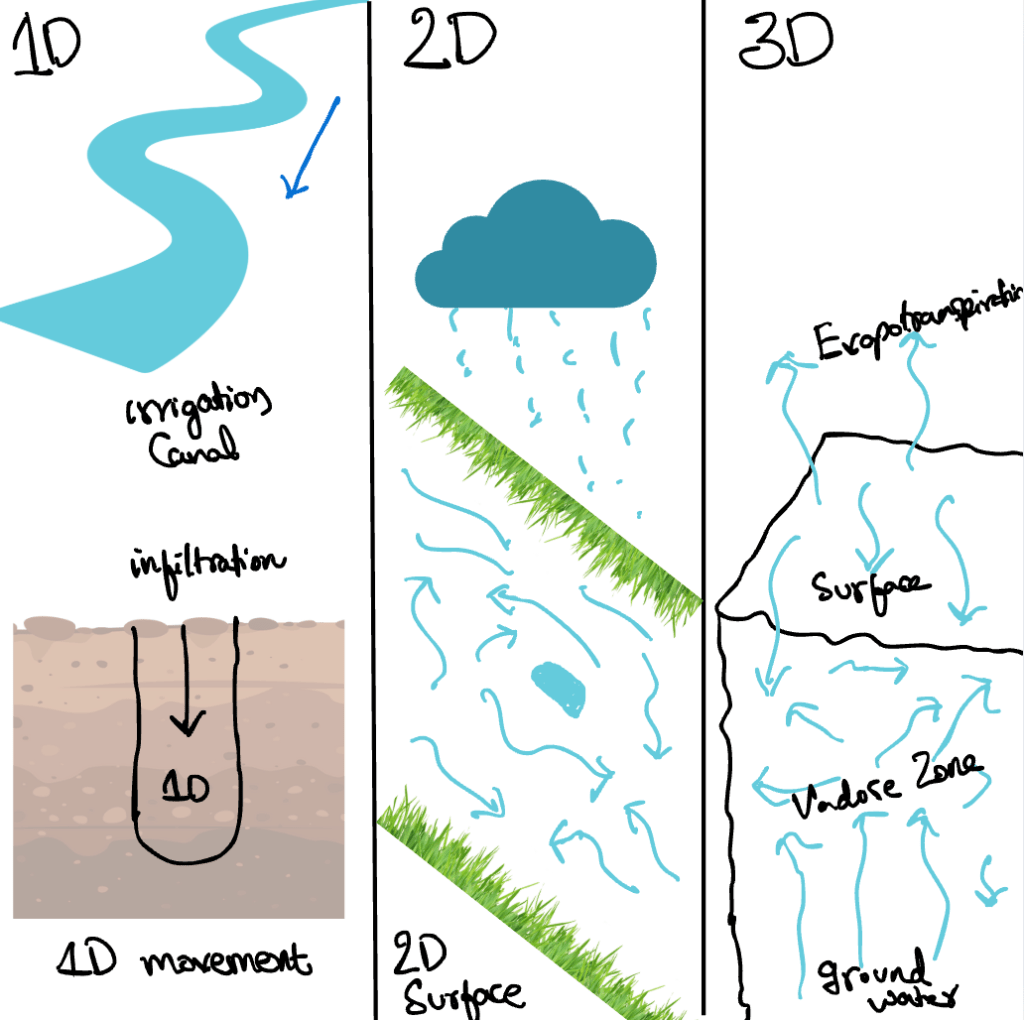
However, not all models are made equal, and their dimensionality, the amount of detail they depict is crucial. While two-dimensional methods aid in our comprehension of surface water spreading and flood hazards, a one-dimensional model might be sufficient to direct the design of an irrigation canal. The relationships between soil, groundwater, and surface water are further captured by three-dimensional models. Using my personal experience as a guide, I will discuss how the different levels of model dimensionality(1D, 2D, and 3D) apply to agriculture, although I acknowledge that the same ideas apply to a wide range of fields.
The Fundamentals of Model Dimensionality Understanding
It’s important to consider what 1D, 2D, and 3D models truly mean in hydrology before deciding when to use them.
After all, depending on gravity, soil, and pressure, water in the real world always flows sideways, downward, or upward rather than in a single direction. However, we don’t need to capture all of that complexity for a lot of real-world issues. Smart approximations that simplify the problem without sacrificing the core of the study are frequently possible.
Figure 1. Conceptual illustration of dimensionality in hydrologic models. 1D captures flow along a single direction (canals, infiltration through soil layers). 2D represents water redistribution across surfaces (rainfall and runoff). 3D incorporates coupled surface–subsurface processes including evapotranspiration, vadose zone flow, and groundwater dynamics.
Let’s get the basics. Name, where you are from, and your current affiliation, advisor and profile?
Hi, my name is Mark Bryan Alivio, and I am originally from a small city, named Valencia, in the island of Mindanao, the Philippines. I received an MSc in Water Science Engineering (Flood Risk Management) through the Erasmus+ Flood Risk Master program. I am currently doing my PhD at the University of Ljubljana, Faculty of Civil and Geodetic Engineering, under the supervision of Prof. Nejc Bezak.
What is the research you are currently working on?
My research focuses on the role of urban trees as nature-based solutions (NbS) for stormwater management in cities. Yes, I know everyone thinks that trees have been extensively studied for their runoff reduction (I got this comment a lot when I opened up what I am currently working on), but that is only true in forest or rural environments, not in an urban setting. Trees in cities exhibit different vegetation characteristics (e.g., leaf area index, canopy structure, phenology) compared to their forest counterparts due to different growing conditions, microclimate, and other factors. Also, the representation of urban trees (even afforestation) in most existing hydrologic models is typically based on land use/land cover type, and the hydrologic response to these changes is used as a basis for determining the equivalent runoff reductions and water quality benefits provided by trees. Also, the data, variables, and/or parameters characterizing trees and the canopy hydrological processes (i.e., interception, throughfall) have been mostly supplemented with findings from studies in natural or rural forests.
A Streams of Thought contribution byGiulio Paradiso.
The Italian Hydrology Days 2025, organized by the Italian Hydrological Society (SII, https://www.sii-ihs.it/), took place at the Polytechnic of Bari from September 8 to 10 under the title “Territorial climate challenges: scenarios, risks and adaptation strategies”, with a strong focus on drought, a theme that in recent years has become increasingly urgent at both national and international level.
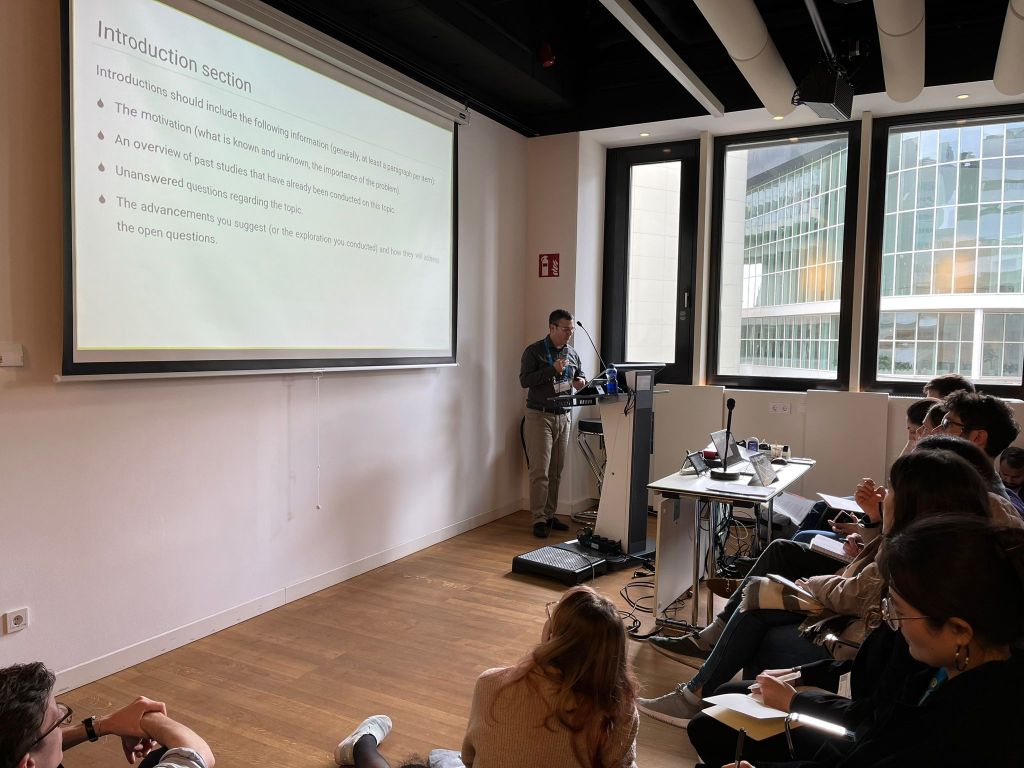
Over three days of exchange and debate, the scientific community presented a wide range of contributions that spanned from fundamental research to applied solutions. Attention was devoted to extreme events, flood risk, groundwater management, environmental quality, droughts and water resources. Drought was, in particular, the main theme of the institutional round table during the second day of the Hydrology Days. As in previous years, the Italian section of the Young Hydrologic Society (YHS-IT) was invited to share the perspective of young Italian hydrologists, a viewpoint shaped during a dedicated meeting held on September 8, which brought together many early-career researchers from across Italian universities in an interactive discussion.
A contribution by Lina Stein, Rodolfo Bezerra Nobrega and Diana Spieler
Talking to parents in academia has shown us that improving their circumstances is a layered challenge that requires a combination of changes in workplace culture, institutional support and policy. In this third part of our blog post series, we share the insights gathered from all the discussions we had with parents across different career stages, including PhD students, postdoctoral fellows, and senior academic researchers. We highlight the benefits and challenges of balancing parenthood with an academic career and summarize the ideas for changes mentioned by these researchers and other sources.
One word that was scattered throughout these conversations was “luck”. “We were lucky that we found a daycare”, “Luckily my supervisor always got my back”, “I have been so lucky with my supervisors”. Since caring for a child requires numerous structural and personal adjustments for parents to reroute their workflows around their new responsibilities, it is the “system” and not luck that should provide the necessary support. Research has shown that a supervisor’s understanding and flexibility regarding parenting responsibilities can significantly impact a parent’s ability to manage both roles effectively (Geraldes et al., 2024). This can give the perception of “luck” playing a role in one’s ability to balance academic and parental responsibilities. We believe that planning for parenthood or living as a parent in academia should not rely on luck, but rather benefit from standardized institutional policies, a shift in workplace culture and supervisor training on the challenges faced by academic parents, so that their success is less dependent on chance and more on structured support. Luck cannot be demanded, structured support can.
“There is still a need for improved support systems within institutions, such as adequate guidance for new mothers, back-up daycare options and comprehensive academic recovery tracking post-childbirth.”
One good example is daycare. As highlighted in the first part of this blog series, a good daycare is worth its weight in gold. Initiatives within academic institutions or conferences that aim to provide childcare support (in daily life or during conferences) need to ensure a certain quality, availability and reliability in their services. Institutions could improve childcare quality by establishing networks that develop and strengthen supportive community connections among parents. Identifying the necessary mechanisms for this support is challenging, particularly as the availability of parental role models is not necessarily granted. This might be due to the legacy and persistence of a capitalist environment that often expects individuals to prioritize work over personal life and is still disadvantaging those with caregiving responsibilities. Establishing clear standards and innovative frameworks in institutions are the basis for shifting the perception of childcare from a basic service to an essential, development-focused resource. David Maslach from Florida State University states that one of these actions would be the creation of a community or network within academic institutions that establishes the foundation for a platform where experiences, resources, and strategies can be shared among parents and caregivers.
“This community can also serve as a space for peer mentorship, where more experienced academics can offer guidance and support to those earlier in their journey. Such communities are so important!” – David Maslach, Florida State University (not part of the survey)
Many researchers also asked for institutions to offer more flexible and supportive policies, such as financial support for accompanying family members when moving to a new institution. One participant highlighted that it is still commonly conveyed by senior scientists that becoming a successful scientist requires working in various places around the world. They often stress the importance of their own experiences in shaping their careers, and this perspective is generally respected without dispute. In Germany, the German Research Foundation (DFG), one of the major funding agencies, until very recently still had specific funding only available for researchers that spend time abroad. While the motivation – providing young researchers with new scientific research methods – is honorable, it ignores the lived reality of families, that cannot easily relocate. Current funding opportunities allow candidates to select institutions within Germany, but they must not have worked longer than one year at the proposed institution. Given the carefully crafted network families rely on to combine work and family life, even moving cities can be extremely challenging. This has been an issue also in other fellowship schemes, such as the ones from the European Union and the UK Research and Innovation. Trisha Greenhalgh and Ed Hawkins argue that penalising fellowship applicants for their choice to not move to new institutions can be highly unfair. As one participant phrased it accurately:
“However, being an involved parent to my children has taught me countless valuable lessons that I doubt I would have learned had I pursued multiple post-doctoral positions at different universities and these lessons surely help me to be a better scientist everyday. In today’s world, it is possible to establish extensive global connections without the need to undertake five post-doctoral positions at five different universities.”
Parents in academia face high pressure and workloads due to the dual responsibilities of career and family life. Many academic mothers report handling not only their professional duties, such as research, teaching, service, and administration, but also shouldering most childcare and household tasks. This burden is sometimes exacerbated by policies that inconsistently account for parental leave in grant eligibility and career progression. Imbalances, rooted in traditional gender roles, underscore the need for policies like extended parental leave for both partners to foster a more equal distribution of responsibilities and provide vital family support. Rigid 9-5 schedules are increasingly unrealistic for new parents, but not all institutions have a framework where parents can block out non-teaching hours.
“I appreciate to have meetings, conferences and sessions to start for example at 9.30am instead of 9am to have time to drop my son off (now, I’m forced to apologise each time a meeting starts at 9am).”
International Institute for Applied Systems Analysis (IIASA) and Lake Victoria Basin Commission/East African Community (LVBC) are happy to report the launch of a new project: Resilience to extreme drought events in East Africa (INTERVENE). The capacity building activities include a € 6,000 grant for students studying in East Africa. The aim is to promote the students’ ongoing research beyond the usual standards and to integrate them into the international research environment of the INTERVENE project. Please find attached a call for applications for your kind consideration and further distribution to colleagues of yours who may be interested.
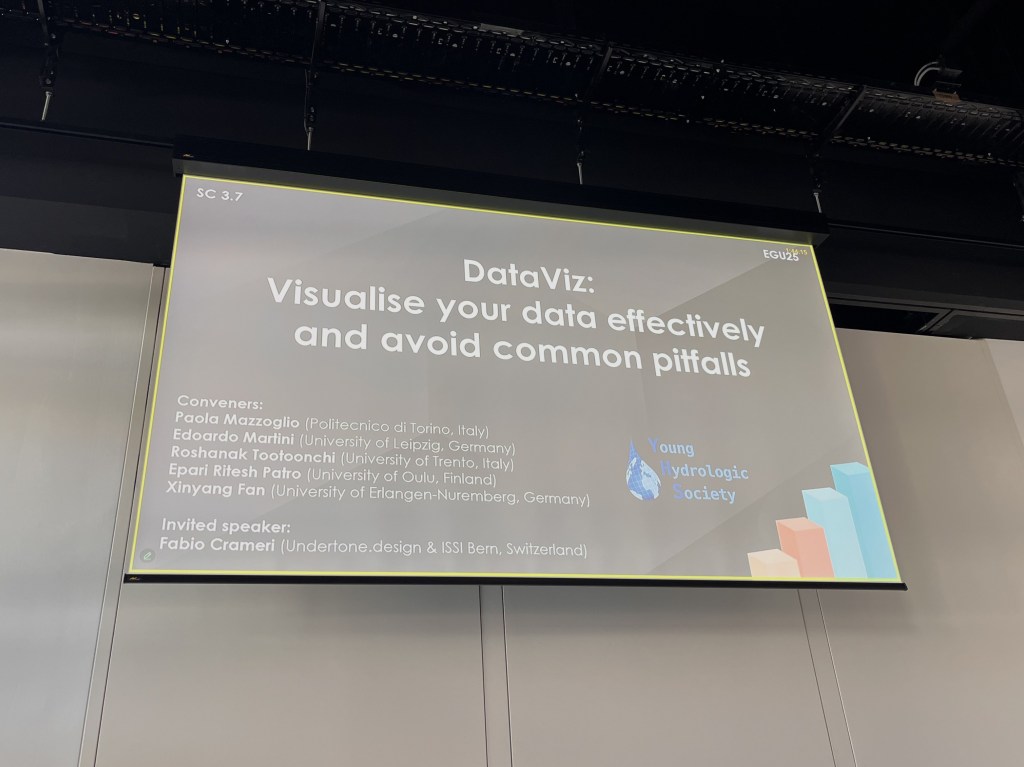
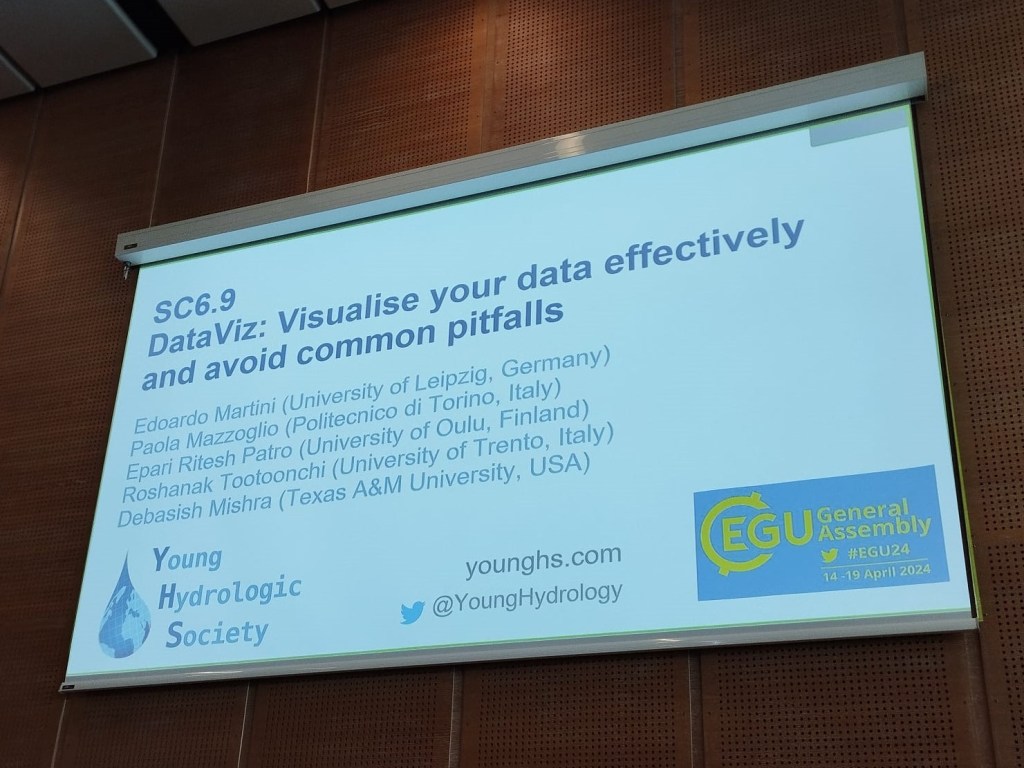
During the EGU General Assembly 2025 in Vienna, the short course “DataViz: Visualise your data effectively and avoid common pitfalls” was once again delivered by the Young Hydrologic Society (YHS). Now a well-established tradition at EGU, this course is designed to equip early-career scientists (and anyone interested) with both inspiration and practical tools to enhance their data visualization skills. In a time when visuals often speak louder and travel faster than words, the ability to create clear, accessible, and visually compelling graphics has become an essential part of scientific communication!
Posted inEGU, Events, News, Resources|TaggedEGU, EGU25, YHS|Comments Off on EGU25 Short Course – DataViz: Visualise your data effectively and avoid common pitfalls
“DataViz: Visualise your data effectively and avoid common pitfalls” is back!
Join us at EGU25 in Vienna to learn how to create clear and effective data visualizations, avoid common mistakes, and explore new tools. This course is ideal for early-career scientists, but open to anyone passionate about improving their communication through better visuals.
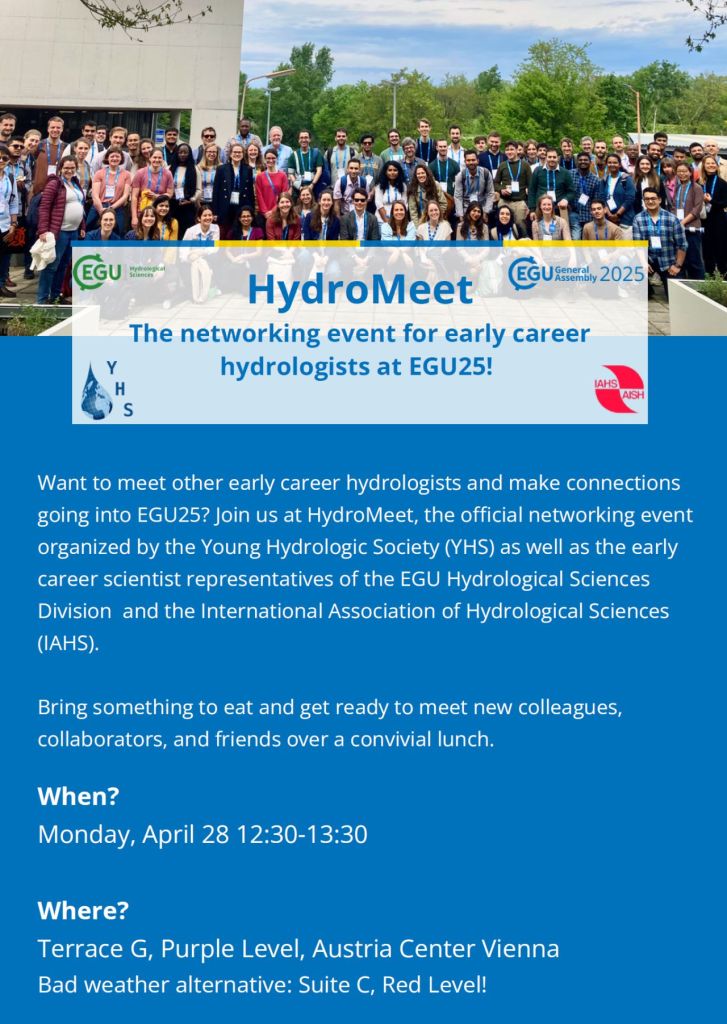
Are you a young hydrologist heading to the EGU25 General Assembly? Join us at the annual pre-GA networking event on April 11th at 2pm CET! 😊
It’s an amazing opportunity to connect with your peers before heading to Vienna, and to learn more about the EGU HS Division as well as the Young Hydrologic Society and the ECS at IAHS (International Association of Hydrological Sciences)!
When I first heard the Gordon Research Conference on Catchment Science described as ‘hydrology summer camp’, I was immediately sold on going. I attended for the first time in 2023, and it ended up being one of the most inspiring and energizing experiences of graduate school so far! Larger conferences such as the annual meetings of the AGU or EGU are great, with the exciting hustle-and-bustle of hundreds of scientists, but I found that the smaller size and unique structure of the GRS and GRC provided a more specialized learning and networking experience. I enjoyed it so much that I volunteered to co-chair the 2025 Seminar, along with Martin Skerlep (Swedish University of Agricultural Sciences), another early-career hydrologist and 2023 attendee. Below, you can read about my personal experience as a PhD student attending the GRS and GRC, and at the end you will find a guide for first-time attendees, which I hope will help you navigate the conference and make the most of your experience!
Posted inEvents, News|TaggedECS, GRC, GRS, YHS|Comments Off on A First-Time Attendee’s Guide to the 2025 Catchment Science Gordon Research Seminar (GRS) and Conference (GRC)
The Young Hydrologic Society (YHS) is a bottom-up initiative to stimulate the interaction and active participation of young hydrologists within the hydrological community.
Founded in October 2012, the YHS is currently run by a team of enthusiastic MScs, PhD students and post-docs from several universities across the world. The YHS board members manage the day-to-day YHS activities: organising conference sessions, creating blog posts and running the YHS social media.
YHS is organised as a group of committees supported by the President and Vice-president. Each board member usually serves a two-year term.
The following committees now have open positions:
Blog: The members of the committee write blog posts, invite contributions to the blog and serve as editors and reviewers. Multiple vacancies.
Outreach: The members of the committee manage the YHS platforms on Bluesky, X, Facebook, and LinkedIn. That includes sharing YHS news, early career events and job opportunities. Multiple vacancies.
Conferences: The members of the committee coordinate YHS-led networking events, short courses and sessions at national and international conferences. For that, it can rely on the support of the entire board and the EGU – IAHS Early Career Representatives. Multiple vacancies.
We, like many other scientific societies, decided to join the Bluesky platform. The scope of this account will be the same as before: we will post updates on conferences, workshops, seminars, webinars, vacancies, etc…
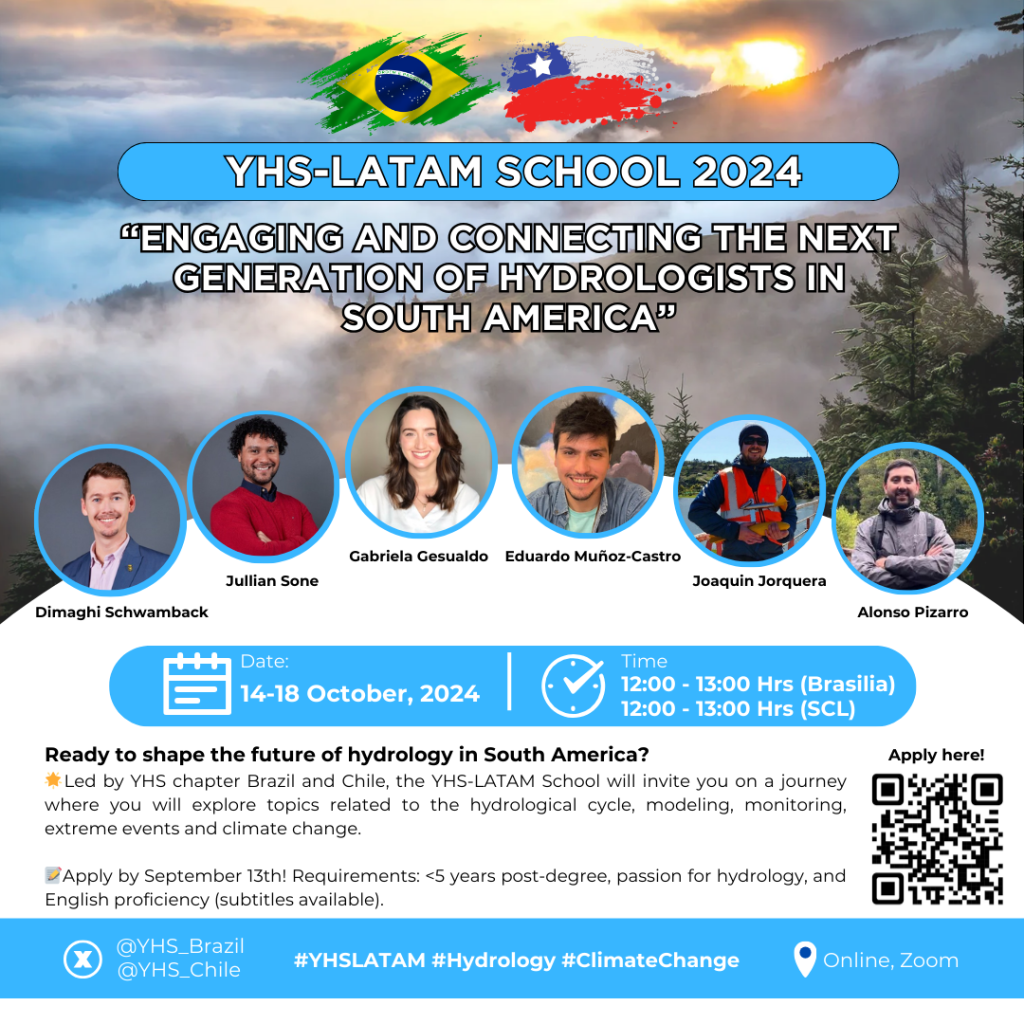
We are thrilled to announce the first Young Hydrologic Society Latin America school (YHS-LATAM school), an event led by the YHS chapters of Brazil and Chile. This event is dedicated to fostering collaboration and innovation among early-career hydrologists across Latin America.
Join us as we delve into critical topics such as water resource management, climate change impacts, and sustainable development. This event promises to be an inspiring and enriching experience for all participants. Check out our preliminary program:
Lecture 1: How is the hydrological cycle in Brazil and Chile? An overview of the hydrological cycle in a warming world Lecture 2: Introduction to hydrological modeling and process-based assessments Lecture 3: Innovative monitoring of hydrological processes Lecture 4: Compounding hydrometeorological extremes event in a warming world Lecture 5: Introduction to climate change, mitigation and adaptation strategies
Pallav Shrestha, Helmholtz Center for Environmental Research
This April (2024), a paper in Water Resources Research caught the attention of our Blog Committee. Intrigued by its innovative findings using a mesoscale hydrology model, we couldn’t resist going deeper. We had the pleasure of discussing this research with Pallav Shrestha, the lead author, and a prominent researcher at the Helmholtz Center for Environmental Research in Germany. Here’s an inside look at our fascinating conversation and the insights we uncovered.
Please introduce yourself to our readers.
I am Pallav Kumar Shrestha. I come from Nepal and currently reside in Germany. I joined the lab of Luis Samaniego at UFZ in 2017 as a PhD researcher, focusing on locally relevant flood forecasting in managed river basins at a global scale. I am one of the active developers of the mesoscale hydrological model (mHM) and the lead developer of the SCC river network upscaling technique and mHM’s reservoir module. My PhD journey is finally coming together with the acceptance of two recent publications: one in Nature Communications and another in Water Resources Research. Today, I’ll delve into the latter.
What led you to integrate a random forest model with the mesoscale Hydrological Model in your study?
While developing the reservoir module in mHM, we were able to satisfactorily represent all aspects of reservoirs based on physics, except for one: the water demand. Demand is a complex human response, highly discontinuous, and is therefore less suited to being modeled as a continuous function like other hydrological processes. For this reason, we hypothesized and demonstrated that machine learning techniques such as random forest could be available option to estimate demand. It is important to note that the random forest modeling exercise was external to mHM, and the fitted demand functions as model input.
Could you explain the significance of the Kling-Gupta Efficiency improvement noted in your study?
Sure. The incorporation of reservoirs in large-scale modeling applications is not a new concept. However, the improvement in Kling-Gupta Efficiency (KGE) for streamflow observed in our study, compared to the naturalized flow, is significantly higher than those reported in previous literature. We succeeded in matching the sub-seasonal details of the observed hydrograph, whereas the majority of previous studies focused only on matching seasonality. The improved KGE implies that modelers can now use mHM to represent reservoir regulation more accurately in their large-scale streamflow simulations.
Posted inResearch "Hylight"|TaggedResearch "Hylight"|Comments Off on Toward Improved Simulations of Disruptive Reservoirs in Global Hydrological Modeling by Shrestha et al. (2024)
A contribution by Diana Spieler, Lina Stein and Rodolfo Bezerra Nobrega
Academia and family are often described as ‘greedy institutions’—a term coined by Coser in 1974. Both demand extensive and open-ended time commitments, which can easily send parents into a spiral of guilt for their perceived inability to fully meet the demands of both their professional and parental roles. This perpetual balancing act is seemingly impossible to perfect. To understand how academic parents navigate these challenges, we asked them how they organize family life around their research demands, how they handle conferences, relocating for the job or their day-to-day routines. This is what they said:
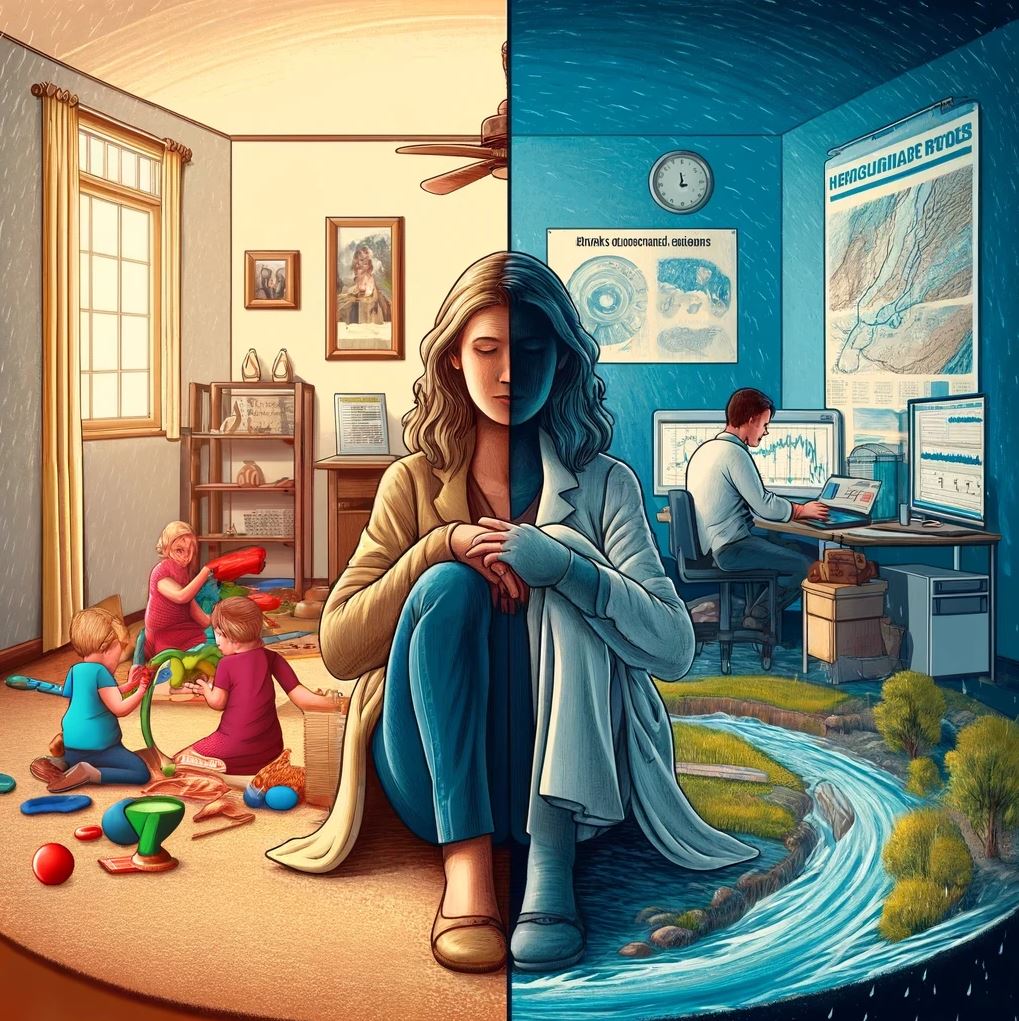
1. Illustration generated by AI technology provided by OpenAI (DALL-E)
Daily Routines
Most parents in our survey reduced their weekly working time to better balance family and career demands. Some choose to work four days a week, while others opt for fewer hours per day. This approach provides flexibility for managing a schedule with kids, particularly when both parents adopt it. By adjusting their work schedules, parents could effectively compensate for each other, stepping in as needed. This however often requires a strong commitment between partners (if not a single carer) in planning daily routines, prioritizing work responsibilities and establishing clear communication channels. It also generally comes with less income.
“Organization” is a big part of our family life. […] This insight did not come naturally to me as I am typically terribly unorganized.”
While a clear weekly structure and distribution of responsibilities seems essential to most, one respondent reminded us that it is also important to stay flexible in your mind for potential sudden changes. Having plans A, B ,C and possibly even G for important meetings or deadlines can be helpful because there is a definite increase in sick days (of parents and children) or the “occasional calls from the principal for less appealing reasons”.
“The most useful strategy for me is to use the early mornings well and to stay flexible in the mind in regards to sudden changes.”
Many parents also shared that they sleep less, wake up early or stay up late to handle their workload or catch up on tasks interrupted by family commitments. To compensate for care hours during the week, they sometimes dedicate time on weekends for work. This practice of overworking is common in science (Kucirkova, 2023) and underscores a systemic failure that is especially hard on parents or anyone not following a direct career path (Staniscuaski, 2024). Effective time management and prioritization of tasks seem crucial for maintaining academic productivity without resorting to 60-hour work weeks. This requires working with high focus and efficiency, particularly if time for additional tasks like reading papers or learning new programming skills is necessary.
“The most useful strategy for balancing work with family life is to have a pretty clear cutoff when leaving work – I’m unavailable from 4 PM onwards – and having a clear plan for how I will use the limited hours that I am in the office.”
While some male respondents acknowledged continuing to work full-time while their wives managed childcare, the majority made deliberate efforts to share childcare responsibilities, aiming for a 50-50 or 60-40 split between partners. Achieving a completely even split was often challenging, especially during the child’s first year, but generally became more feasible starting at the age of 1.5 to 3 years old. Shared childcare duties also helped distribute the care of a sick child, arranging schedules around meetings, deadlines and fieldwork and promoting a more equitable distribution of the mental load, which is often disproportionately borne by mothers. One male respondent who worked full-time found it difficult to take parental leave when his child was born, despite being legally allowed. He deliberately advertised to claim your rights and speak up for yourself when it comes to parental leave and reduced working hours as he regretted that it took him at least 8 years before he felt like it was okay to take time off for family.
“We need role models! Especially for men that often only know their own fathers as sole providers and mothers as sole caregiver.”
Posted inNews, Picture|Taggedparents in academia, YHS, YHS Blog|Comments Off on Navigating parenthood as an early career scientist – Part 2: The question of organization.
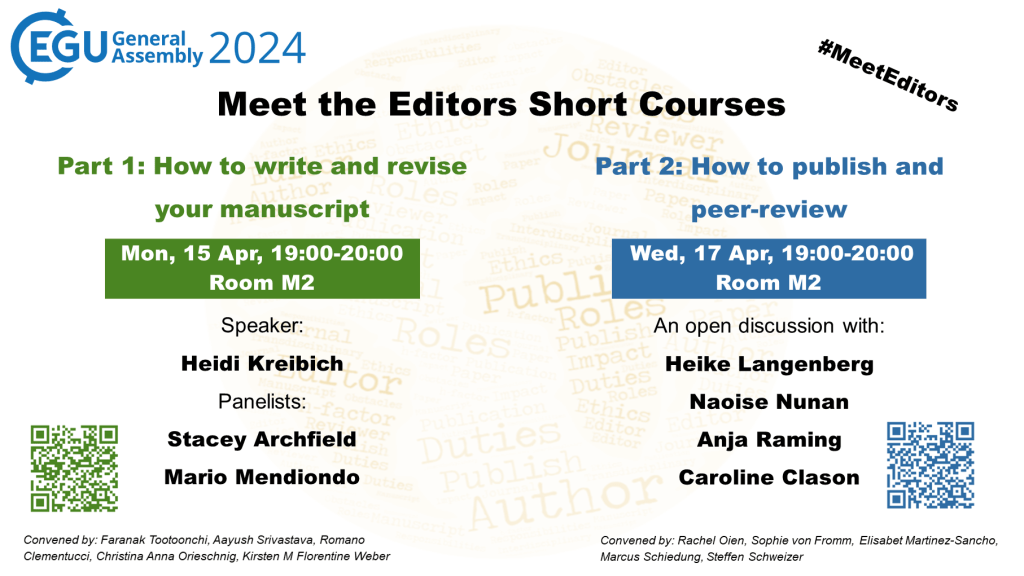
During EGU24, Young hydrologic society and Early career hydrologic sub-division co-organized the short course ‘Meet the editors part 1’. The session was highly well received, thanks to our speaker Dr. Heidi Kreibich and two panelists Dr. Mario Mendiondo, and Dr. Stacey Archfield!
All our speakers raised the importance of mental health before, during and after publication.
Posted inEGU, News|TaggedDataViz, EGU, EGU24, YHS|Comments Off on EGU24 Short Course – DataViz: Meet the editors (1): how to write and revise your manuscript
IAHS is delighted to announce a call for abstracts for an upcoming 2-days workshop focusing on the interface of urbanization and water management strategies, with a particular emphasis on addressing challenges and opportunities in the global south.
The workshop is hosted by LMU Munich, organized by the Urban Water Working Group of the IAHS under the HELPING decade, and supported by LMU Munich Postdoc Support funding and Carl Friedrich von Siemens Stiftung.
Abstracts should be submitted online by May 15th, 2024.
During the conference EGU General Assembly 2024 held in Vienna a few days ago, the Short Course “DataViz: Visualise your data effectively and avoid common pitfalls” was delivered. This course was co-organized by the Young Hydrologic Society (YHS) and was designed to help scientists (early career scientists in particular) improve their data visualization skills in a way that the research outputs would be more accessible, less biased and more understandable within the scientific community.
Posted inEGU, News|TaggedDataViz, EGU, EGU24, YHS|Comments Off on EGU24 Short Course – DataViz: Visualise your data effectively and avoid common pitfalls
A contribution by Lina Stein, Rodolfo Bezerra Nobrega and Diana Spieler
Raising a child in combination with a full-time career is no easy feat. That is true in general and maybe even more true in academia. Juggling the workload, conference attendance, or the potential requirement to move to a new job all become more demanding when children or other caretaking responsibilities are competing with each other. One would think that academia — a presumed flexible work environment — should be ideal for working parents, but often the focus on productivity measured in publications and funding secured does not make it easy to combine parenthood with science. As a result, around 34% of mothers leave STEM academia after having their first child (Powell, 2021). That is a huge loss of scientific talent.
1.Photo by Michał Parzuchowski on Unsplash
“I’m a bit disillusioned about this system here […] I think eventually I will have to leave the university” — Female Postdoc in Germany.
Making parenthood more compatible with scientific careers demands systematic and societal changes. We know what works to start with: subsidized childcare, onsite childcare, flexible working schedules, and supportive working environments (Feeney & Stritch, 2019); but the implementation of the basics is still lacking in many institutions.
“A good daycare is worth its weight in gold.”
For this blog series, we gathered views on challenges, advice, and suggested changes in academia from several working parents in hydrology. Our aim is to offer reinforcement to early career scientists who are managing or going to take on childcare responsibilities. What is the best time during your career to have a kid? (Spoiler alert: there is no best time). How to best organize the work-life-kids balance? How to manage conferences, school holidays, or moving because of a new job. We extend this blog series with a list of recommendations to institutions on how they can take a leading role in implementing these systematic changes needed in our field to reduce the hassle for child caretakers.
We contacted several parents in research through our network and asked them to snowball our survey. The response was very enthusiastic: 20 people, equally split between women and men, answered with at times multiple pages of text. It shows that the topic really hit a nerve. The responses are mostly from Europe, though some Canadian, Australian and US perspectives are included as well.
In our blog series, we try to summarize the responses we got under three broad topics:
Timing. At what time during their academic career did people have children and what were the pros and cons of that.
Organisation. How do you best organize family life with research demands?
Systematic change. What needs to be done to improve the support of parents in academia?
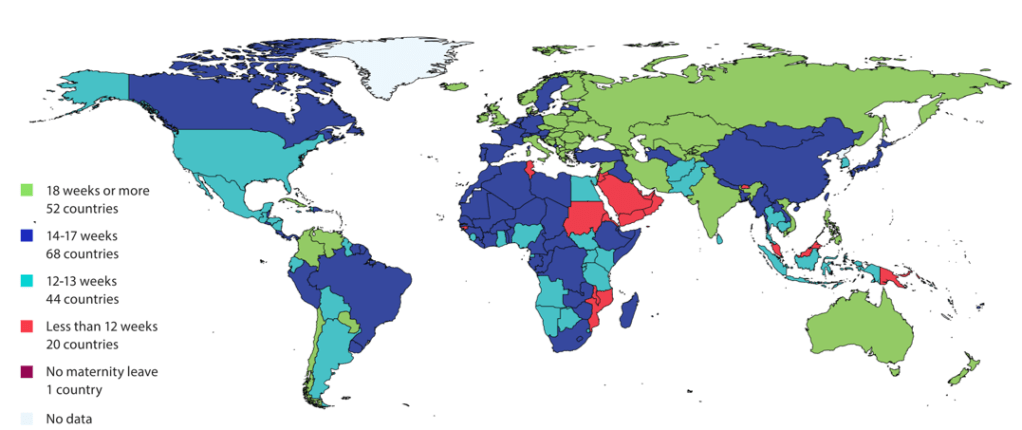
2. Duration of maternity leave in 2021 with data from the International Labour Organization (Source: Care at Work Report, ILO).
Preparing a manuscript for submission to a scientific journal can be a challenging task for many scientists. If you would like to improve your skills, please consider that during EGU24 two Short Courses on these topics will be delivered!
Are you attending the EGU-GA for the first time? Or have you already been in Vienna and wanna share some tips with your colleagues?
Join our Pre-EGU Online Networking Event! Come for the annual Early Career Hydrology Meet and Greet between hydrologists from institutions around the world. Bring your drink of choice and get to know some of your colleagues before the upcoming EGU conference!
Join the British Hydrological Society and Young Hydrologic Society for the March 2024 episode of “Gotta catch’em all”! The speaker will be Samuel Watkiss, from JBA Consulting and JBA Trust Ltd.
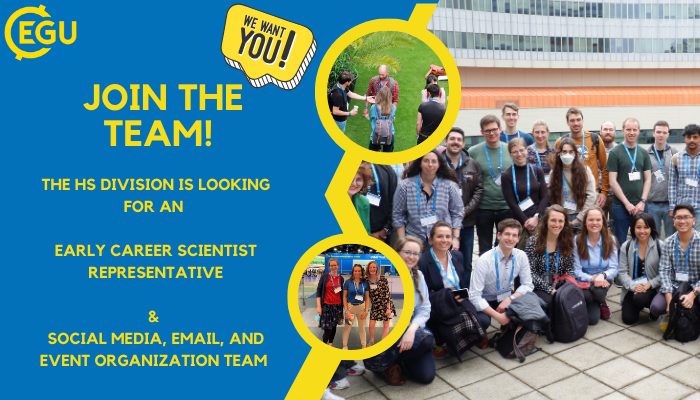
With the General Assembly of the European Geosciences Union (EGU) in Vienna (April 14-19) approaching fast, it’s time to assemble the new team to represent Early Career Scientists (ECS) of the Hydrological Sciences (HS) Division!
Posted inEGU, News|TaggedECS, ECS Rep, EGU, HS, Hydrological Sciences|Comments Off on Early Career Scientist Rep for Hydrological Sciences Division of EGU: applications open
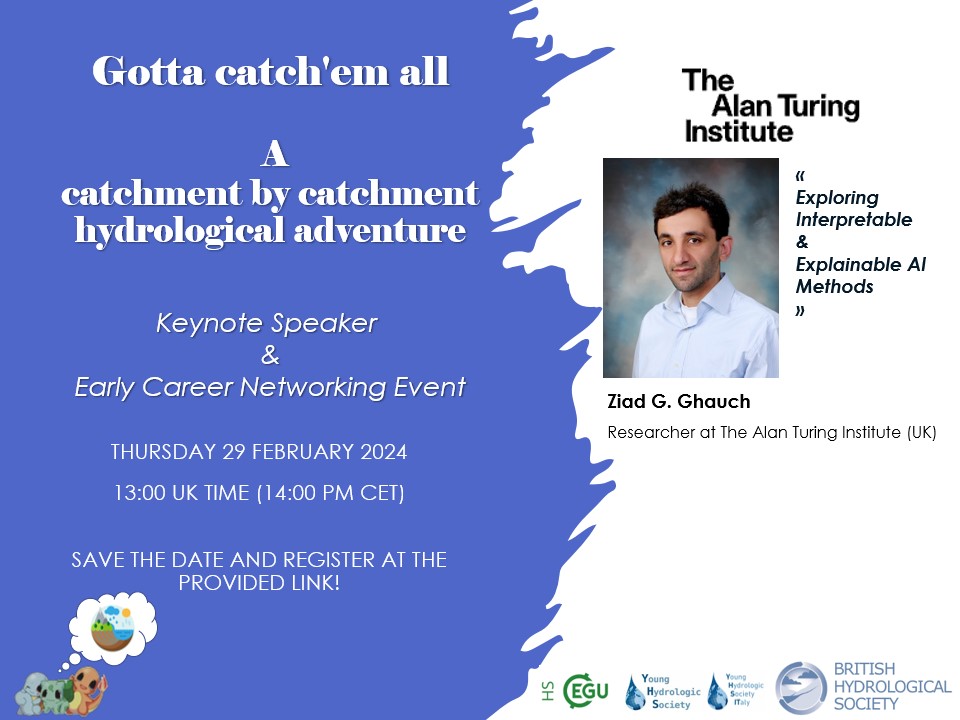
Thursday, 29th of February 2024, 13:00 to 14:00 UK time, join the British Hydrological Society and Young Hydrologic Society for the first 2024 episode where Dr Ziad G. Ghauch from The Alan Turing Institute will show how to find an escape in the AI labyrinth and use it to protect our critical infrastructure.
The Young Hydrologic Society (YHS) is a bottom-up initiative to stimulate the interaction and active participation of young hydrologists within the hydrological community.
Founded in October 2012 the YHS is currently run by a team of enthusiastic MScs, PhD students and post-docs from several universities across the world. The YHS board members manage the day to day YHS activities: organising conference sessions, creating blog posts and running the YHS twitter account.
YHS is organised as a group of committees supported by the president and secretary. Each board member usually serves a two-year term.
The following committees have open positions:
Blog: The members of the committee invite contributions to the blog and serve as editors and reviewers. There is a close connection to the EGU Hydrological Sciences, HEPEX and AGU H3S blogs in the form of joint blog posts. Multiple vacancies.
Outreach: The members of the committee manage the YHS platforms on Twitter, Facebook and LinkedIn. That includes sharing YHS news, early career events and job opportunities. 1 vacancy.
Conferences: The members of the committee coordinate YHS-led networking events, short courses and sessions at national and international conferences. For that it can rely on the support of the entire board and the EGU Early Career Representative. Multiple vacancies.
We welcome applications from all Early Career Hydrologists. If you have any questions about the positions you are welcome to contact current or former chairs.
Election Procedure:
Open call for candidates until 5th December 2023. Interested candidates are invited to apply by sending a 200-word statement of purpose for the role along with a 2-page CV to younghydrologicsociety@gmail.com.
Based on the applications a short list for each open position is created by the current president+secretary. Based on the short list the current YHS board selects the new YHS members.
The new committee members are announced by late January and will start their 2-year term from early February 2024.
Posted inNews|TaggedYHS|Comments Off on Call for applicants – YHS Board
A Streams of Thought contribution by Nikolas Galli
The Italian Hydrology Days, the annual meeting of the Italian Hydrological Society (IHS, https://www.sii-ihs.it/), have taken place recently in Matera (Figure 1). In the context of a city that is a UNESCO world heritage also for its unique ancient water infrastructures, hydrologists from all of Italy and beyond have met to discuss the issue of complexity in water management, this year’s conference theme. The three days in Matera have also seen a strong contribution from the Italian branch of the Young Hydrologic Society (YHS-IT), not only to the local restaurants and bars’ businesses, but also to the conference’s activities.
Figure 1 – A photo of Matera: definitely not an ugly location for a conference!Continue reading →
Posted inStreams of Thought|TaggedConference, Matera, YHS, YHS-IT|Comments Off on Complex problems require shared solutions: highlights and lessons learned from the Italian Hydrology Days
A Streams of Thought contribution by Hayat Nasirova
The deep sea, the largest ecosystem on earth and one of the least explored, is home to high biodiversity and offers an abundance of resources (Ramirez-Llodra et al., 2011).
The Ocean Foundation (https://oceanfdn.org/) defines deep sea mining (DSM) as a commercial industry aimed at mining mineral deposits on the sea floor to extract commercially valuable minerals such as manganese, copper, cobalt, zinc and rare earth elements. Although humans have exploited the oceans for millennia, technological developments now allow the exploitation of fisheries resources, hydrocarbons, and minerals below 2000 m depth (Ramirez-Llodra et al., 2011). The mineral deposits are found in three seafloor habitats: the abyssal plains, seamounts and hydrothermal vents (Gollner et al., 2017). Abyssal plains are large parts of the deep ocean floor covered with deposits of sediment and minerals, also called polymetallic nodules and this is currently the main goal of DSM. With an increasing demand for mineral resources, deep-sea mining brought a critical threshold to the ecosystem (Gollner et al., 2017). This is because the depletion of minerals has irreversible consequences that can lead to the loss of habitats, species, and ecosystem services which are unlikely to recover to their original state (Thompson et al., 2018).
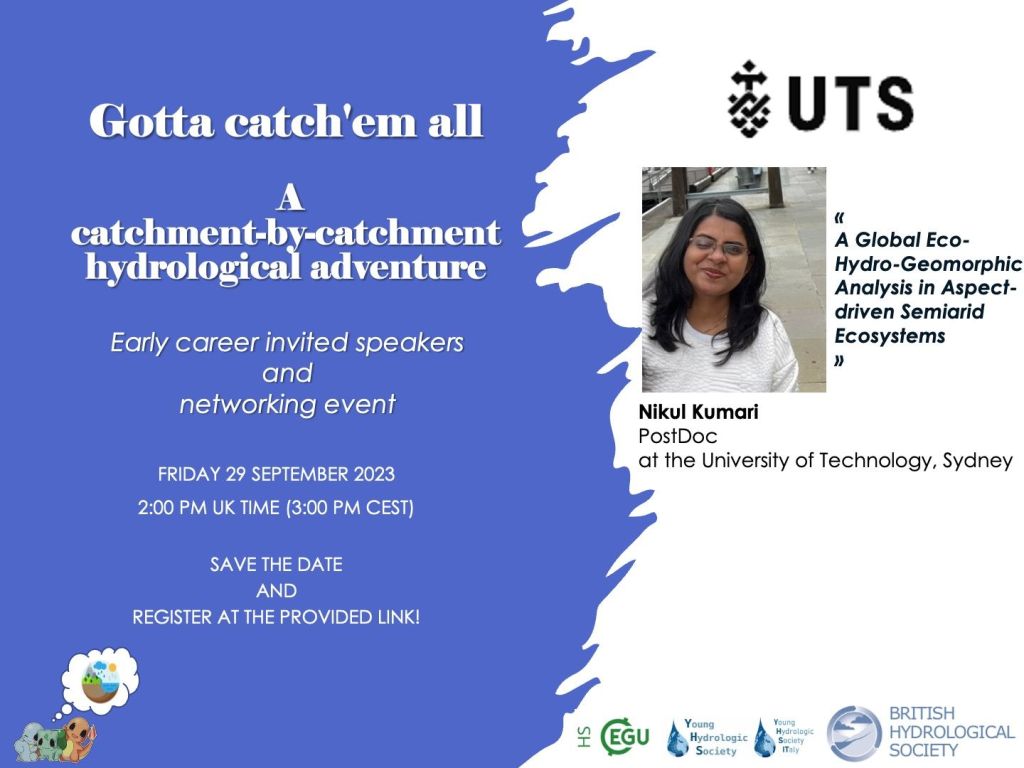
Join the British Hydrological Society and the Young Hydrologic Society for the September episode of “Gotta catch’em all”. Our speaker will be Nikul Kumari, PostDoc at the University of Technology, Sydney. She will present her work titled: “A Global Eco-Hydro-Geomorphic Analysis in Aspect-driven Semiarid Ecosystems”. Get your free online seat at https://events.teams.microsoft.com/event/05a5fad1-50c7-457c-82f8-5c4b2bc82f2d@b2e47f30-cd7d-4a4e-a5da-b18cf1a4151b to hear about the behaviour of deserts. Looking forward to seeing you there!
The idea for YHS India originated during the EGU 2023 conference. Dr Ankit Agarwal from IIT Roorkee noticed that several young hydrologists, including students pursuing Master’s and PhD degrees, postdoctoral fellows, scientists, and early-career Professors, were attending the conference from different universities in India. Surprisingly, despite their substantial presence, many of them were unaware of the various opportunities available at EGU. Additionally, there was a lack of connection among these participants as well as there is no formal framework to connect and collaborate. As a result, several young participants gathered to discuss how they could improve their connections, disseminate information, find PhD partners across borders, propose innovative ideas, and enhance their presentation skills.
Recognizing this gap, Dr. Ankit Agarwal (IIT Roorkee), Dr. Bramha Dutt Vishwakarma (IISC), Dr. Priyank Sharma (IIT Indore) and Dr. Vamsi Krishna Vema (NIT Warangal) realized the need for a platform that would bring together young hydrologists in India and foster collaboration and knowledge exchange between them. Indeed, the Young Hydrologic Society (YHS) is a bottom-up initiative to stimulate the interaction and active participation of young hydrologists within the hydrological community. Founded in October 2012 the YHS is currently run by a team of enthusiastic MSc’s, PhD’s and post-doc’s from several universities across Europe.
Dr. Ankit and many interested students had a meeting with Dr Lina Stein to initiate the YHS India Chapter. The membership is free and open to all interested young hydrologists. If you are interested, you can register here for the mail distributor.
A Streams of Thought contribution by Hayat Nasirova
The Caspian Sea (CS) is the largest lake on Earth. It is located at the intersection of Europe and Asia. It is called “sea” because it has an ocean-type earth layer at the bottom as being a remnant of the Tethys Ocean and has the dimensions of a sea. The water level is variable, currently it is approximately -28 meters below the ocean level.
The current worry of some hydrologists is whether the CS will follow the same fate as the Aral lake. NASA’s Global Water Monitor, which uses radar altimetry data collected by multiple satellites, shows changes in water levels in the CS since the mid-1990s (Figure 1).
Figure 1: a) Regions affected by severe drying as projected for 2080–2099 with major lakes located in the region indicated in bright red. Many of these lakes are already experiencing drying. Map data: Google Earth, Landsat/Copernicus (data from SIO/NOAA, U.S. Navy, NGA, GEBCO, IBCAO, USGS). b) Impact of Caspian Sea Level(CSL) projections of −9 m and −18 m at the end of the twenty-first century. Red regions fall dry.
A Streams of Thought contribution by Paola Mazzoglio and Miriam Bertola.
The potential of citizen science in hydrology
Citizen scientists (i.e., volunteers who help conducting tasks in scientific research) have the potential to play an important role in hydrology. The main advantage of Citizen science initiatives is that they engage a broad range of individuals since no previous knowledge of the research topic is needed, including ordinary people, students, and educators, and both sides benefit from this collaboration. On the one hand, these initiatives are opportunities to disseminate scientific knowledge and awareness to the public about water-related challenges. On the other hand, citizens contribute to collective tasks that speed up scientific research.
The role of citizen scientists is generally the collection and the analysis of data on water resources or on some component of the water cycle, mainly in terms of quantity and quality. This includes taking measurements of streamflow, rainfall, water temperature, pH, dissolved oxygen, and other parameters using simple, low-cost tools such as meters, test kits, computers and smartphones. Citizen scientists can, for example, collect water samples for laboratory analysis, which provide information on nutrient levels, sediment loads, and the presence of contaminants. In addition to collecting data, citizen scientists can assist in analyzing and interpreting it.
Preparing a manuscript for submission to a scientific journal may be hard work for many scientists. Still, scientific writing is an essential step of the research process, because the form used to present the results is often as important as the results themselves. Writing a scientific paper is a skill that can be acquired with time, while becoming easier with practice.
During the conference EGU23 held in Vienna, the Short Course “Meet the editors (1): how to write and revise your manuscript” was delivered. This short course gave early career scientists simple guidelines on writing about their work and increase the chance of publishing it.
Nadav Peleg, assistant professor at the University of Lausanne, was lecturer of this course. Dr. Peleg is an editor in the Hydrology and Earth System Sciences (HESS) journal and Journal of Hydrology.
Visualisation of scientific data is an integral part of scientific understanding and communication. Scientists have to make decisions about the most effective way to communicate their results everyday. How do we best visualise the data to understand it ourselves? How do we best visualise our results to communicate with others? Common pitfalls can be overcrowding, overcomplicated plot types or inaccessible color schemes. Scientists may also get overwhelmed by the graphics requirements of different publishers, for presentations, posters etc.
During the conference EGU23 held in Vienna, the Short Course “DataViz: Visualise your data effectively and avoid common pitfalls” was delivered. This course was co-organized by the Young Hydrologic Society (YHS) and was designed to help scientists improve their data visualization skills in a way that the research outputs would be more accessible within their own scientific community and reach a wider audience.
Posted inEGU, News|TaggedDataViz, EGU, EGU23, Short Course|Comments Off on EGU23 Short Course – DataViz: Visualise your data effectively and avoid common pitfalls
One of the major challenges in water resources management today and in the coming future is reducing the risk related to extreme events, i.e. floods and droughts, mainly through a reliable flow prediction. Large-scale hydrological models have been widely proposed to gain insights into dominant water processes, quantify the role of human-water interactions, and identify emergent global patterns in a changing world.
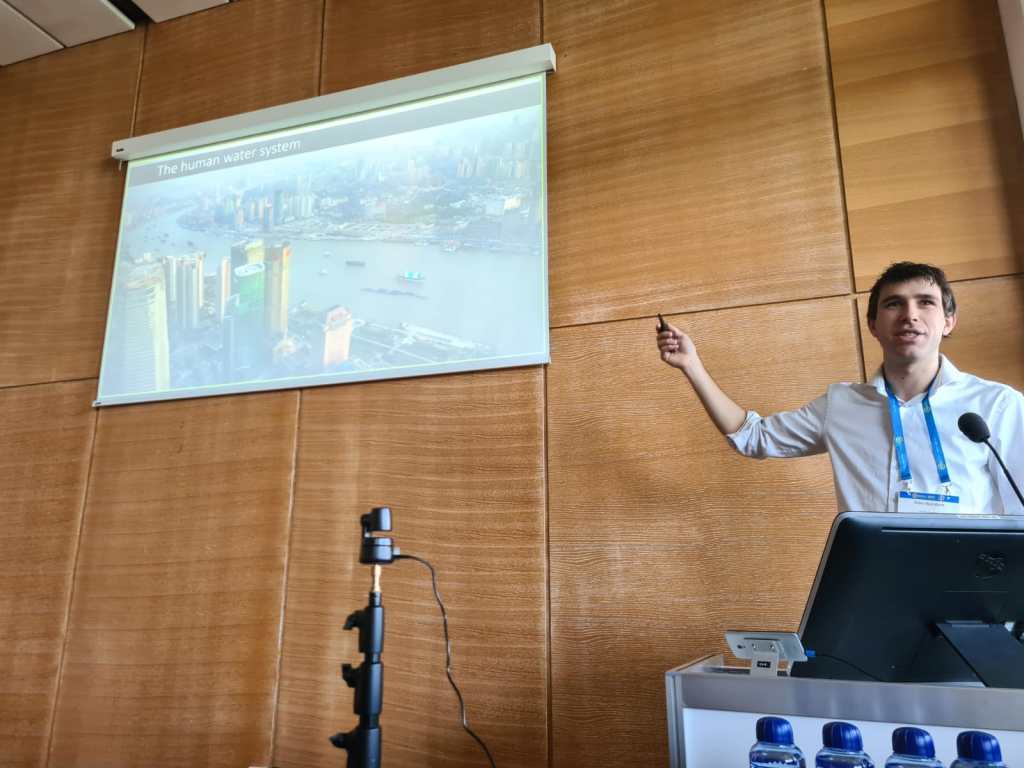
During the conference EGU23 held in Vienna, the Short Course “Hydroinformatics for hydrology: Introduction to large-scale hydrological modelling” was delivered. This course was co-organized by the Young Hydrologic Society (YHS). Dr. Niko Wanders from Utrecht University was the lecturer of this course.
Posted inEGU, News|TaggedEGU, EGU23, Short Course|Comments Off on EGU23 Short Course – Hydroinformatics for hydrology: Introduction to large-scale hydrological modelling
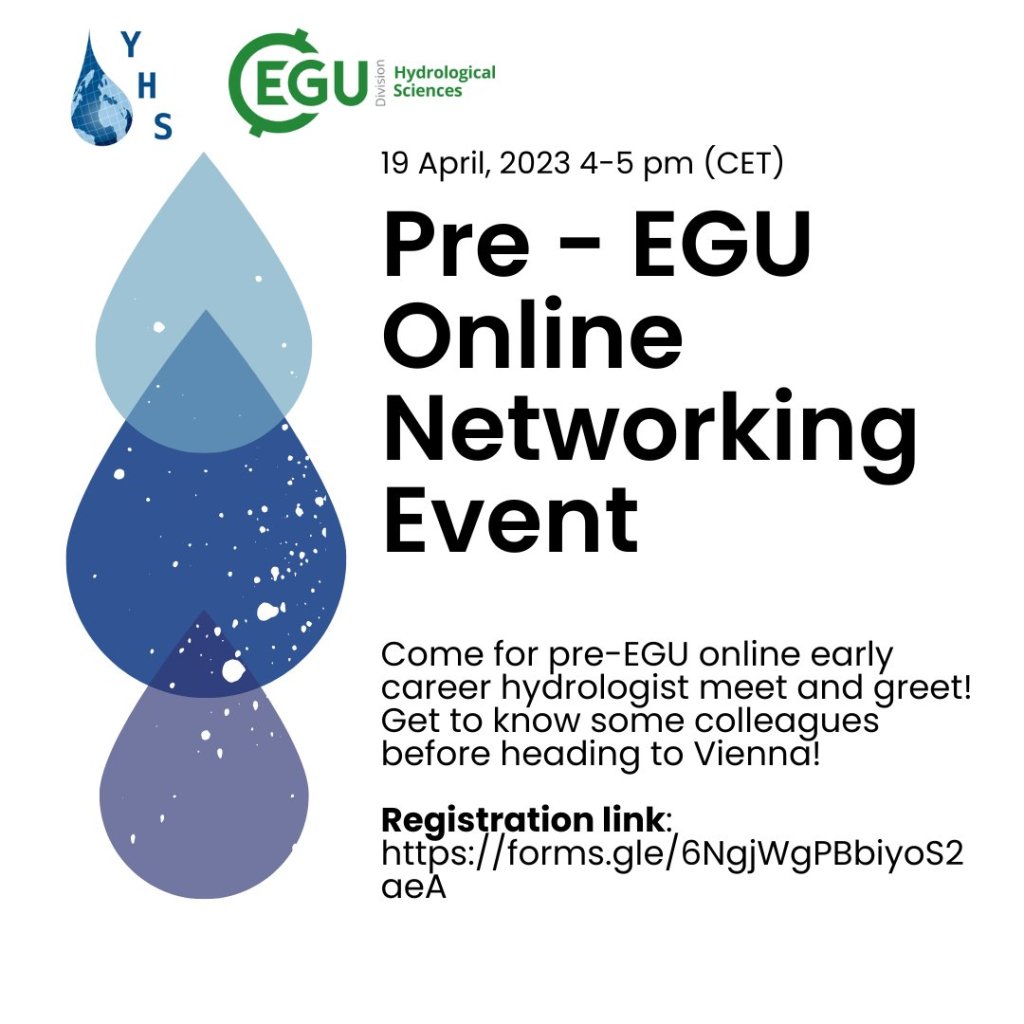
Are you attending the EGU-GA for the first time? Or have you already been in Vienna and wanna share some tips with your colleagues?
Join our Pre-EGU Online Networking Event! Come for the annual Early Career Hydrology Meet and Greet between hydrologists from institutions around the world. Bring your drink of choice and get to know some of your colleagues before the upcoming EGU conference!
Let’s get the basics. Name, where you are from, and your current affiliation and advisor?
My name is Athanasios V. Serafeim, and I originate from a small city in Northern Greece named Edessa. I recently received my Ph.D. from the Department of Civil Engineering at the University of Patras, under the supervision of Prof. Andreas Langousis. Currently, I serve as a postdoctoral research associate at the University of Patras focusing on the design, monitoring and management of urban water networks, while working also as a consultant of TECHNOR Engineering LTD (https://technor.gr/en/).
What is the research you are currently working on?
My main research focuses on the development of an integrated, theoretically founded, and practically applicable methodological framework for resilient reduction of leakages in water distribution networks (WDNs), which combines: a) a set of probabilistic approaches for minimum night flow (MNF) estimation and parametric modeling of water losses in WDNs, and b) a combination of statistical clustering and hydraulic modeling techniques for WDN partitioning into pressure management areas (PMAs; or districted metered areas, DMAs). A side project I am currently working on investigates the effects of COVID-19 pandemic on domestic water consumption patterns.
Alberto graduated in Environmental Engineering at the Politecnico di Torino (Italy) with a thesis on “Turbulence structures in the canopy layer”. He carried out his Ph.D. on the theme “Non-supervised statistical methods for the prediction of hydrological variables in ungauged sites” at the Hydraulic Department of Politecnico di Torino (2004-2007). He worked as a Research Fellow at TU Wien (Austria) in the field of “Flood Hydrology” from 2007 until 2018. Since 2019 he is an Associate Professor at the Politecnico di Torino. He is currently EGU HS Division Deputy President and, in April, he will become EGU HS President for the years 2023–2025.
PM. Was becoming a scientist your career plan when you were a student? Did you envision yourself as a professor at any point? If not, which events led to where you are now?
AV. I can say I have been fascinated by science since I was a kid. “Il mondo di Quark”, a popular Italian science television show, was always in my allowed daily ration of TV (I had to sacrifice a cartoon for it, but it was worth it). And I liked scientists in comics, books, and movies. For sure I didn’t imagine I would have ended up being a scientist, though. Well, I don’t consider myself a scientist anyway… but I couldn’t imagine I would have become a professor at the university, and that has happened!
If you work in research, sooner or later you will be asked to attend a scientific conference. In Hydrology, there is a whole host of conferences to choose from. The usual suspects would be the big ones: AGU, EGU, IAHS… but what about the small ones? Here, I want to talk about a small conference that I went to a few years ago (in 2019 to be exact), the Gordon Research Conference. I liked it so much that I directly volunteered to be the early career chair for the next one. Well, with Covid that chair position took a bit longer that usual, but this year, finally, the next Gordon Research Conference (or GRC for short) in Catchment Science will take place.
The Gordon Research Conference in Catchment Science: Interactions of Hydrology, Biology and Geochemistry is a five-day conference in New Hampshire, USA, every two years. In the two days before the GRC the Gordon Research Seminar (GRS), the early career conference takes place.
Join us for the second episode of “Gotta catch’em all” talk organized by the British Hydrological Society and the Young Hydrologic Society to hear about Indiana Jones-like hydrology discoveries and the first-ever type of network.
Luca Brocca received the M.Sc. degree in Environmental Engineering and the Ph.D. degree in Civil Engineering, both with excellence, from the University of Perugia, Italy, in 2003 and 2008, respectively. Since 2009 he is a Researcher at the National Research Council (CNR), Research Institute for Geo-Hydrological Protection (IRPI) of Perugia (Italy). Since 2019 he is the Director of Research at the same institute. The main research interest of Luca Brocca lies in the development of innovative methods for exploiting satellite observations for hydrological applications (webpage).
PM. Can you tell us a little bit about your background and education? Was becoming a scientist your career plan when you were a student?
LB. I always enjoyed mathematics and environmental science, that’s why I have selected environmental engineering in my city, Perugia. I started studying hydrology because I did my master thesis in this field, then as soon as I got my degree I was selected at CNR-IRPI for a scholarship in Hydrology, and here I am. I did my PhD for studying soil moisture spatial-temporal variability and its use for hydrological modeling, all my career so far has been around the soil moisture topic. The long-term satellite soil moisture product (ESA CCI soil moisture) started in November 1978, the month I was born; I don’t think this is by chance! By the way, I am not a typical researcher as I did my studies and I always worked in my city (with just a very short period abroad)!
Faranak (FT) is the incoming President for the Young Hydrologic Society. Here the outgoing President Lina (LS) interviews her about what it is like finishing the PhD, why she would recommend people to join YHS, and what she plans for the future.
LS: You just finished your PhD. Congratulations! How does it feel?
FT: It feels great but a bit sad as well. It feels good, because I actually wrapped up this chapter. At the same time, it is sad not to be a student anymore. I feel a bit nostalgic because I really had good time as a PhD student in Uppsala university.
Picture taken the night before the day of Faranak’s defense.Continue reading →
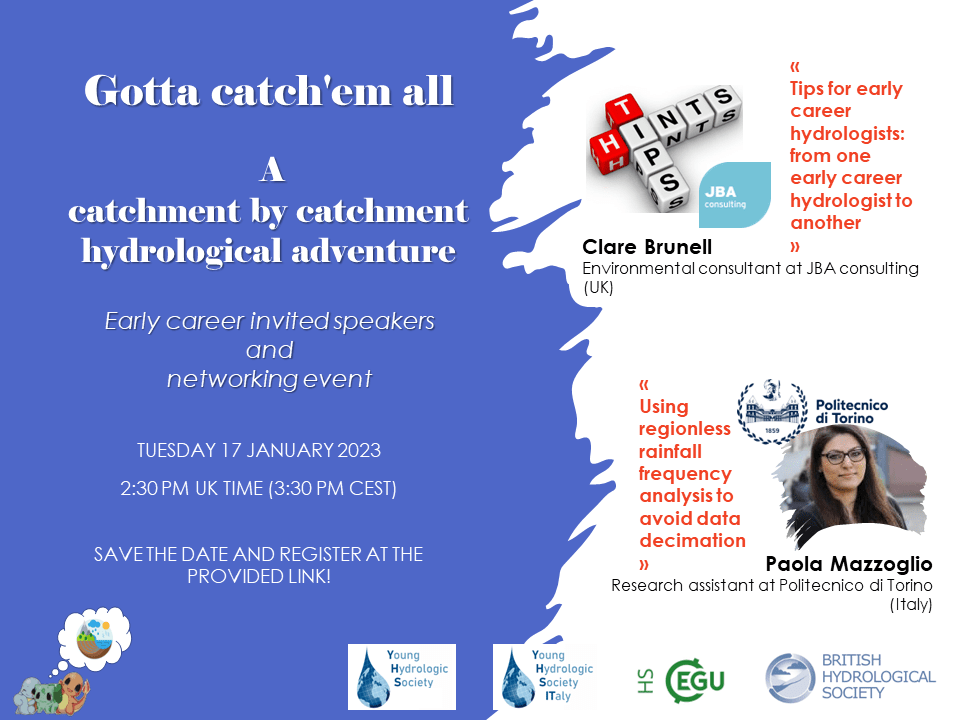
The British Hydrological Society and Young Hydrologic Society would invite you to join the first “Gotta catch’em all” talk on 17th January 2023, 14:30-15:30 CEST. The speakers will talk about hydrology tips and rainfall data decimation.
Heidi Kreibich is head of the working group “Flood risk and climate adaptation” at the Section Hydrology, German Research Centre for Geosciences GFZ. Heidi’s research is focused on flood risk assessment and mitigation with a background in Environmental engineering, Hydrology and Geography. Heidi is particularly interested in understanding and modelling flood damage processes and in human-flood interaction. She coordinates the IAHS Panta Rhei Working group “Changes in flood risk”.
PM. Can you tell us a little bit about your background and education? Was becoming a scientist your career plan when you were a student?
I studied environmental engineering at the Technical University of Berlin. Coming from a village in Bavaria, studying in the highly dynamic city of Berlin right after reunification opened up a new world for me. I had a wide range of interests, participated in independent student projects such as self-organised seminars on feminist environmental research and also completed internships in consulting companies, administration and research institutions. Above all, my study project during an Erasmus semester at Lancaster University, UK with Prof. Kevin Jones and my diploma thesis at CSIRO in Melbourne, Australia under the supervision of Dr. Rob Gillett awakened my passion for science and I decided to do a PhD and go into research.


















 Young Hydrologic Society