Choosing the Right Hydrologic Model for Agriculture: 1D, 2D, or 3D?

Written by Sathyanarayan Rao

Introduction

Many hydrologists face the same dilemma sooner or later: do I really need a 3D model for this, or will a simple 1D line do the job? That question only makes sense once we step back and look at the bigger picture: why water management itself has become such a pressing issue. Water management has emerged as a key issue in the debate over food security as communities around the world struggle to feed an expanding population while dealing with the strains of resource scarcity, shifting land use, and climate uncertainty. Beyond agriculture, hydrology supports energy production, flood protection, urban water supply, and ecosystem preservation. However, its significance is especially apparent in agriculture. When rainfall is erratic, rivers are stressed, and groundwater supplies are depleting, it can be difficult to reliably supply crops with the water they need at the right time and location.

Here’s where hydrologic modeling comes in handy. Models enable us to forecast results, simulate various scenarios, and develop strategies that would otherwise be impossible to test on a large scale in the field by converting the complexity of water movement into organized, testable frameworks. In agriculture, this could entail determining how irrigation affects soil moisture, forecasting floodwater pooling locations on farmland, or estimating the long-term effects of groundwater extraction on crop viability. Modeling gives us the information we need to make better decisions, but it does not resolve issues on its own.

However, not all models are made equal, and their dimensionality, the amount of detail they depict is crucial. While two-dimensional methods aid in our comprehension of surface water spreading and flood hazards, a one-dimensional model might be sufficient to direct the design of an irrigation canal. The relationships between soil, groundwater, and surface water are further captured by three-dimensional models. Using my personal experience as a guide, I will discuss how the different levels of model dimensionality(1D, 2D, and 3D) apply to agriculture, although I acknowledge that the same ideas apply to a wide range of fields.

The Fundamentals of Model Dimensionality Understanding

It’s important to consider what 1D, 2D, and 3D models truly mean in hydrology before deciding when to use them.

After all, depending on gravity, soil, and pressure, water in the real world always flows sideways, downward, or upward rather than in a single direction. However, we don’t need to capture all of that complexity for a lot of real-world issues. Smart approximations that simplify the problem without sacrificing the core of the study are frequently possible.

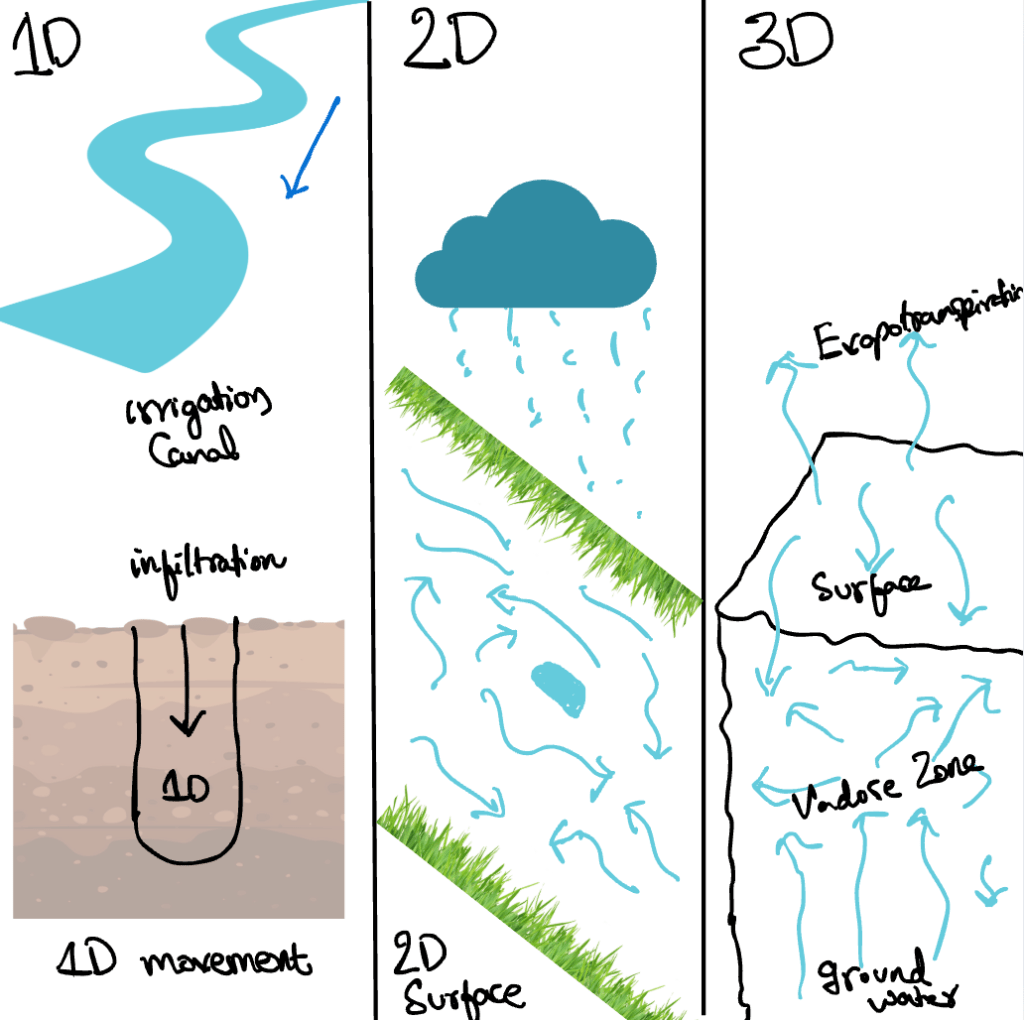
Figure 1. Conceptual illustration of dimensionality in hydrologic models. 1D captures flow along a single direction (canals, infiltration through soil layers). 2D represents water redistribution across surfaces (rainfall and runoff). 3D incorporates coupled surface–subsurface processes including evapotranspiration, vadose zone flow, and groundwater dynamics.

Continue reading
Posted in News, Streams of Thought | Tagged , , , | Comments Off on Choosing the Right Hydrologic Model for Agriculture: 1D, 2D, or 3D?

Profile Series: Mark Bryan Alivio

Let’s get the basics. Name, where you are from, and your current affiliation, advisor and profile?
Hi, my name is Mark Bryan Alivio, and I am originally from a small city, named Valencia, in the island of Mindanao, the Philippines. I received an MSc in Water Science Engineering (Flood Risk Management) through the Erasmus+ Flood Risk Master program. I am currently doing my PhD at the University of Ljubljana, Faculty of Civil and Geodetic Engineering, under the supervision of Prof. Nejc Bezak.

What is the research you are currently working on?

My research focuses on the role of urban trees as nature-based solutions (NbS) for stormwater management in cities. Yes, I know everyone thinks that trees have been extensively studied for their runoff reduction (I got this comment a lot when I opened up what I am currently working on), but that is only true in forest or rural environments, not in an urban setting. Trees in cities exhibit different vegetation characteristics (e.g., leaf area index, canopy structure, phenology) compared to their forest counterparts due to different growing conditions, microclimate, and other factors. Also, the representation of urban trees (even afforestation) in most existing hydrologic models is typically based on land use/land cover type, and the hydrologic response to these changes is used as a basis for determining the equivalent runoff reductions and water quality benefits provided by trees. Also, the data, variables, and/or parameters characterizing trees and the canopy hydrological processes (i.e., interception, throughfall) have been mostly supplemented with findings from studies in natural or rural forests. 

Continue reading
Posted in EGU, News, Profile Series | Tagged , | Comments Off on Profile Series: Mark Bryan Alivio

The Italian Hydrology Days 2025: climate challenges, drought, and new perspectives

A Streams of Thought contribution by Giulio Paradiso.

The Italian Hydrology Days 2025, organized by the Italian Hydrological Society (SII, https://www.sii-ihs.it/), took place at the Polytechnic of Bari from September 8 to 10 under the title “Territorial climate challenges: scenarios, risks and adaptation strategies”, with a strong focus on drought, a theme that in recent years has become increasingly urgent at both national and international level.

Over three days of exchange and debate, the scientific community presented a wide range of contributions that spanned from fundamental research to applied solutions. Attention was devoted to extreme events, flood risk, groundwater management, environmental quality, droughts and water resources. Drought was, in particular, the main theme of the institutional round table during the second day of the Hydrology Days. As in previous years, the Italian section of the Young Hydrologic Society (YHS-IT) was invited to share the perspective of young Italian hydrologists, a viewpoint shaped during a dedicated meeting held on September 8, which brought together many early-career researchers from across Italian universities in an interactive discussion.

Continue reading
Posted in Events, News, Streams of Thought | Tagged , , | Comments Off on The Italian Hydrology Days 2025: climate challenges, drought, and new perspectives

Navigating parenthood as an early career scientist – Part 3: Systematic change

A contribution by Lina Stein, Rodolfo Bezerra Nobrega and Diana Spieler

Talking to parents in academia has shown us that improving their circumstances is a layered challenge that requires a combination of changes in workplace culture, institutional support and policy. In this third part of our blog post series, we share the insights gathered from all the discussions we had with parents across different career stages, including PhD students, postdoctoral fellows, and senior academic researchers. We highlight the benefits and challenges of balancing parenthood with an academic career and summarize the ideas for changes mentioned by these researchers and other sources.

Photo by Claudio Schwarz on Unsplash

One word that was scattered throughout these conversations was “luck”. “We were lucky that we found a daycare”, “Luckily my supervisor always got my back”, “I have been so lucky with my supervisors”. Since caring for a child requires numerous structural and personal adjustments for parents to reroute their workflows around their new responsibilities, it is the “system” and not luck that should provide the necessary support. Research has shown that a supervisor’s understanding and flexibility regarding parenting responsibilities can significantly impact a parent’s ability to manage both roles effectively (Geraldes et al., 2024). This can give the perception of “luck” playing a role in one’s ability to balance academic and parental responsibilities. We believe that planning for parenthood or living as a parent in academia should not rely on luck, but rather benefit from standardized institutional policies, a shift in workplace culture and supervisor training on the challenges faced by academic parents, so that their success is less dependent on chance and more on structured support. Luck cannot be demanded, structured support can. 

“There is still a need for improved support systems within institutions, such as adequate guidance for new mothers, back-up daycare options and comprehensive academic recovery tracking post-childbirth.”

One good example is daycare. As highlighted in the first part of this blog series, a good daycare is worth its weight in gold. Initiatives within academic institutions or conferences that aim to provide childcare support (in daily life or during conferences) need to ensure a certain quality, availability and reliability in their services. Institutions could improve childcare quality by establishing networks that develop and strengthen supportive community connections among parents. Identifying the necessary mechanisms for this support is challenging, particularly as the availability of parental role models is not necessarily granted. This might be due to the legacy and persistence of a capitalist environment that often expects individuals to prioritize work over personal life and is still disadvantaging those with caregiving responsibilities. Establishing clear standards and innovative frameworks in institutions are the basis for shifting the perception of childcare from a basic service to an essential, development-focused resource. David Maslach from Florida State University states that one of these actions would be the creation of a community or network within academic institutions that establishes the foundation for a platform where experiences, resources, and strategies can be shared among parents and caregivers. 

“This community can also serve as a space for peer mentorship, where more experienced academics can offer guidance and support to those earlier in their journey. Such communities are so important!”
David Maslach, Florida State University (not part of the survey)

Many researchers also asked for institutions to offer more flexible and supportive policies, such as financial support for accompanying family members when moving to a new institution. One participant highlighted that it is still commonly conveyed by senior scientists that becoming a successful scientist requires working in various places around the world. They often stress the importance of their own experiences in shaping their careers, and this perspective is generally respected without dispute. In Germany, the German Research Foundation (DFG), one of the major funding agencies, until very recently still had specific funding only available for researchers that spend time abroad. While the motivation – providing young researchers with new scientific research methods – is honorable, it ignores the lived reality of families, that cannot easily relocate. Current funding opportunities allow candidates to select institutions within Germany, but they must not have worked longer than one year at the proposed institution. Given the carefully crafted network families rely on to combine work and family life, even moving cities can be extremely challenging. This has been an issue also in other fellowship schemes, such as the ones from the European Union and the UK Research and Innovation. Trisha Greenhalgh and Ed Hawkins argue that penalising fellowship applicants for their choice to not move to new institutions can be highly unfair. As one participant phrased it accurately:

“However, being an involved parent to my children has taught me countless valuable lessons that I doubt I would have learned had I pursued multiple post-doctoral positions at different universities and these lessons surely help me to be a better scientist everyday. In today’s world, it is possible to establish extensive global connections without the need to undertake five post-doctoral positions at five different universities.”

Parents in academia face high pressure and workloads due to the dual responsibilities of career and family life. Many academic mothers report handling not only their professional duties, such as research, teaching, service, and administration, but also shouldering most childcare and household tasks. This burden is sometimes exacerbated by policies that inconsistently account for parental leave in grant eligibility and career progression. Imbalances, rooted in traditional gender roles, underscore the need for policies like extended parental leave for both partners to foster a more equal distribution of responsibilities and provide vital family support. Rigid 9-5 schedules are increasingly unrealistic for new parents, but not all institutions have a framework where parents can block out non-teaching hours.

“I appreciate to have meetings, conferences and sessions to start for example at 9.30am instead of 9am to have time to drop my son off (now, I’m forced to apologise each time a meeting starts at 9am).”

Continue reading
Posted in News, Picture | Tagged , , , | Comments Off on Navigating parenthood as an early career scientist – Part 3: Systematic change

INTERVENE project – Grant for students studying in East Africa

International Institute for Applied Systems Analysis (IIASA) and Lake Victoria Basin Commission/East African Community (LVBC) are happy to report the launch of a new project: Resilience to extreme drought events in East Africa (INTERVENE). The capacity building activities include a € 6,000 grant for students studying in East Africa. The aim is to promote the students’ ongoing research beyond the usual standards and to integrate them into the international research environment of the INTERVENE project. Please find attached a call for applications for your kind consideration and further distribution to colleagues of yours who may be interested.

Continue reading
Posted in News | Comments Off on INTERVENE project – Grant for students studying in East Africa