
With the General Assembly of the European Geosciences Union (EGU) in Vienna (April 14-19) approaching fast, it’s time to assemble the new team to represent Early Career Scientists (ECS) of the Hydrological Sciences (HS) Division!

With the General Assembly of the European Geosciences Union (EGU) in Vienna (April 14-19) approaching fast, it’s time to assemble the new team to represent Early Career Scientists (ECS) of the Hydrological Sciences (HS) Division!
Thursday, 29th of February 2024, 13:00 to 14:00 UK time, join the British Hydrological Society and Young Hydrologic Society for the first 2024 episode where Dr Ziad G. Ghauch from The Alan Turing Institute will show how to find an escape in the AI labyrinth and use it to protect our critical infrastructure.
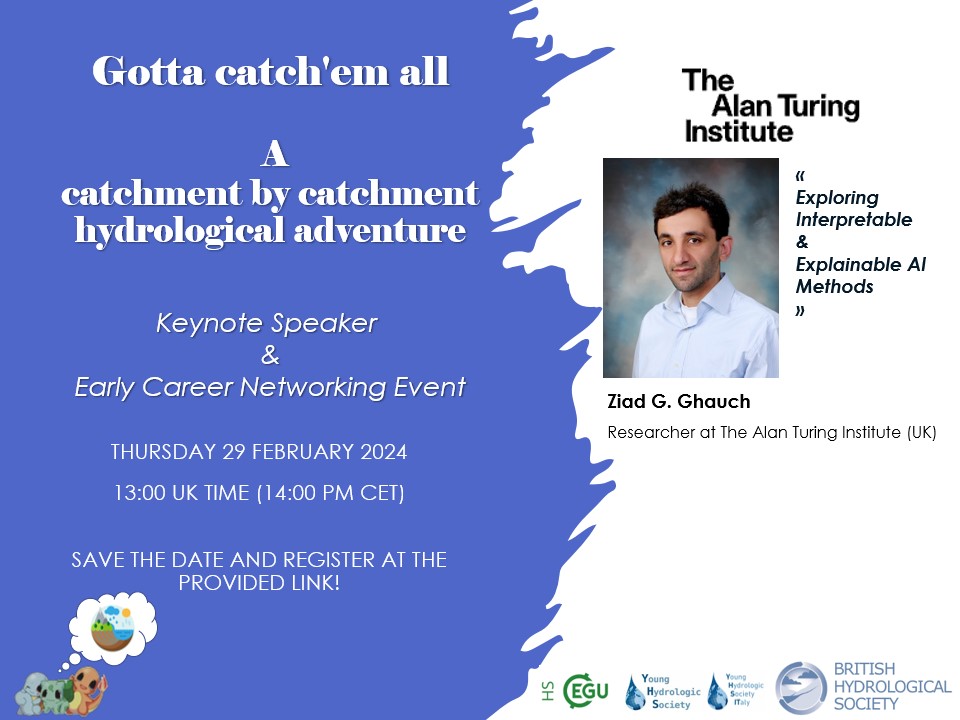
Get your free online seat at: https://events.teams.microsoft.com/event/fe8eaf2e-4096-4515-91d6-5c4111b5feb9@b2e47f30-cd7d-4a4e-a5da-b18cf1a4151b. Looking forward to seeing you there!
Continue readingThe Young Hydrologic Society (YHS) is a bottom-up initiative to stimulate the interaction and active participation of young hydrologists within the hydrological community.
Founded in October 2012 the YHS is currently run by a team of enthusiastic MScs, PhD students and post-docs from several universities across the world. The YHS board members manage the day to day YHS activities: organising conference sessions, creating blog posts and running the YHS twitter account.
YHS is organised as a group of committees supported by the president and secretary. Each board member usually serves a two-year term.
The following committees have open positions:
Blog: The members of the committee invite contributions to the blog and serve as editors and reviewers. There is a close connection to the EGU Hydrological Sciences, HEPEX and AGU H3S blogs in the form of joint blog posts. Multiple vacancies.
National Branches: The members of the committee support new and established national YHS branches and national representatives where necessary Multiple vacancies.
Outreach: The members of the committee manage the YHS platforms on Twitter, Facebook and LinkedIn. That includes sharing YHS news, early career events and job opportunities. 1 vacancy.
Conferences: The members of the committee coordinate YHS-led networking events, short courses and sessions at national and international conferences. For that it can rely on the support of the entire board and the EGU Early Career Representative. Multiple vacancies.
We welcome applications from all Early Career Hydrologists. If you have any questions about the positions you are welcome to contact current or former chairs.
Election Procedure:
A Streams of Thought contribution by Nikolas Galli
The Italian Hydrology Days, the annual meeting of the Italian Hydrological Society (IHS, https://www.sii-ihs.it/), have taken place recently in Matera (Figure 1). In the context of a city that is a UNESCO world heritage also for its unique ancient water infrastructures, hydrologists from all of Italy and beyond have met to discuss the issue of complexity in water management, this year’s conference theme. The three days in Matera have also seen a strong contribution from the Italian branch of the Young Hydrologic Society (YHS-IT), not only to the local restaurants and bars’ businesses, but also to the conference’s activities.

A Streams of Thought contribution by Hayat Nasirova
The deep sea, the largest ecosystem on earth and one of the least explored, is home to high biodiversity and offers an abundance of resources (Ramirez-Llodra et al., 2011).
The Ocean Foundation (https://oceanfdn.org/) defines deep sea mining (DSM) as a commercial industry aimed at mining mineral deposits on the sea floor to extract commercially valuable minerals such as manganese, copper, cobalt, zinc and rare earth elements. Although humans have exploited the oceans for millennia, technological developments now allow the exploitation of fisheries resources, hydrocarbons, and minerals below 2000 m depth (Ramirez-Llodra et al., 2011). The mineral deposits are found in three seafloor habitats: the abyssal plains, seamounts and hydrothermal vents (Gollner et al., 2017). Abyssal plains are large parts of the deep ocean floor covered with deposits of sediment and minerals, also called polymetallic nodules and this is currently the main goal of DSM. With an increasing demand for mineral resources, deep-sea mining brought a critical threshold to the ecosystem (Gollner et al., 2017). This is because the depletion of minerals has irreversible consequences that can lead to the loss of habitats, species, and ecosystem services which are unlikely to recover to their original state (Thompson et al., 2018).
Continue reading Young Hydrologic Society