EGU24 Short Course – DataViz: Meet the editors (1): how to write and revise your manuscript

During EGU24, Young hydrologic society and Early career hydrologic sub-division co-organized the short course ‘Meet the editors part 1’.
The session was highly well received, thanks to our speaker Dr. Heidi Kreibich and two panelists Dr. Mario Mendiondo, and Dr. Stacey Archfield!

All our speakers raised the importance of mental health before, during and after publication.

Picture taken during the EGU24 short course.
Continue reading
Posted in EGU, News | Tagged , , , | Comments Off on EGU24 Short Course – DataViz: Meet the editors (1): how to write and revise your manuscript

International Workshop on Urbanization and Sustainable Water management strategies

IAHS is delighted to announce a call for abstracts for an upcoming 2-days workshop focusing on the interface of urbanization and water management strategies, with a particular emphasis on addressing challenges and opportunities in the global south.

The workshop is hosted by LMU Munich, organized by the Urban Water Working Group of the IAHS under the HELPING decade, and supported by LMU Munich Postdoc Support funding and Carl Friedrich von Siemens Stiftung.

Abstracts should be submitted online by May 15th, 2024.

Additional information available at https://survey.ifkw.lmu.de/iahs_UrbanWater_2024/

Posted in News | Tagged | Comments Off on International Workshop on Urbanization and Sustainable Water management strategies

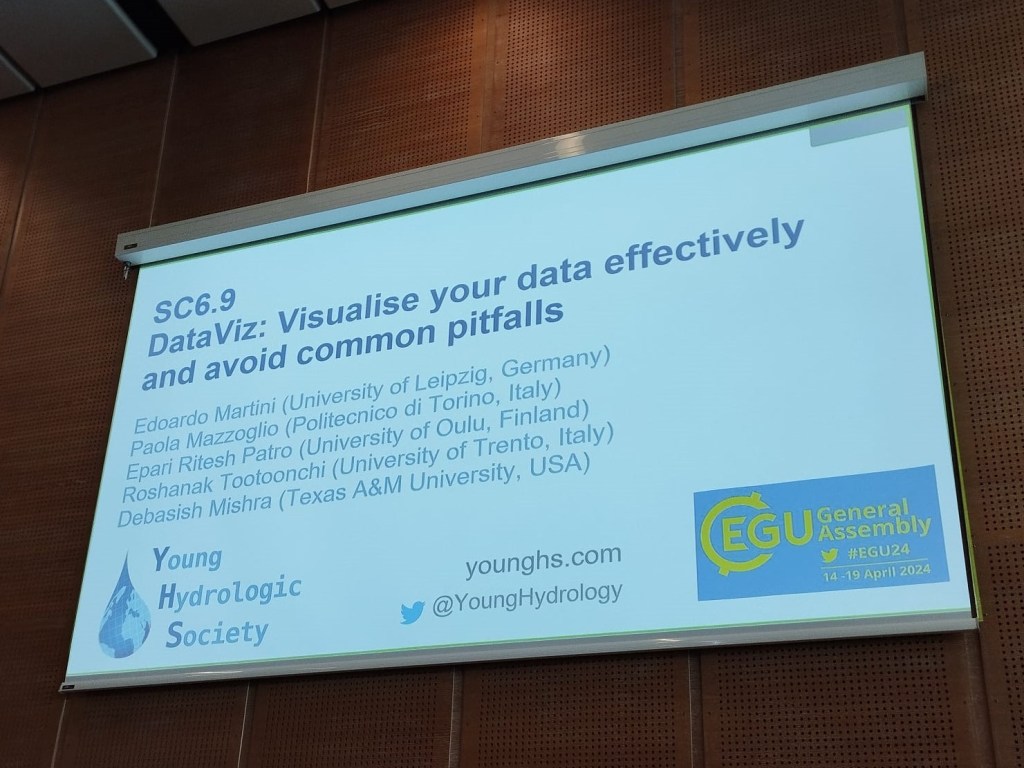
EGU24 Short Course – DataViz: Visualise your data effectively and avoid common pitfalls

During the conference EGU General Assembly 2024 held in Vienna a few days ago, the Short Course “DataViz: Visualise your data effectively and avoid common pitfalls” was delivered. This course was co-organized by the Young Hydrologic Society (YHS) and was designed to help scientists (early career scientists in particular) improve their data visualization skills in a way that the research outputs would be more accessible, less biased and more understandable within the scientific community.

Picture taken during the EGU24 short course.
Continue reading
Posted in EGU, News | Tagged , , , | Comments Off on EGU24 Short Course – DataViz: Visualise your data effectively and avoid common pitfalls

Navigating parenthood as an early career scientist: insights and challenges from hydrological sciences – Part 1

A contribution by Lina Stein, Rodolfo Bezerra Nobrega and Diana Spieler

Raising a child in combination with a full-time career is no easy feat. That is true in general and maybe even more true in academia. Juggling the workload, conference attendance, or the potential requirement to move to a new job all become more demanding when children or other caretaking responsibilities are competing with each other. One would think that academia — a presumed flexible work environment — should be ideal for working parents, but often the focus on productivity measured in publications and funding secured does not make it easy to combine parenthood with science. As a result, around 34% of mothers leave STEM academia after having their first child (Powell, 2021). That is a huge loss of scientific talent. 

1.Photo by Michał Parzuchowski on Unsplash

“I’m a bit disillusioned about this system here […] I think eventually I will have to leave the university” — Female Postdoc in Germany.

Making parenthood more compatible with scientific careers demands systematic and societal changes. We know what works to start with: subsidized childcare, onsite childcare, flexible working schedules, and supportive working environments (Feeney & Stritch, 2019); but the implementation of the basics is still lacking in many institutions.

“A good daycare is worth its weight in gold.”

For this blog series, we gathered views on challenges, advice, and suggested changes in academia from several working parents in hydrology. Our aim is to offer reinforcement to early career scientists who are managing or going to take on childcare responsibilities.  What is the best time during your career to have a kid? (Spoiler alert: there is no best time). How to best organize the work-life-kids balance? How to manage conferences, school holidays, or moving because of a new job. We extend this blog series with a list of recommendations to institutions on how they can take a leading role in implementing these systematic changes needed in our field to reduce the hassle for child caretakers.

We contacted several parents in research through our network and asked them to snowball our survey. The response was very enthusiastic: 20 people, equally split between women and men, answered with at times multiple pages of text. It shows that the topic really hit a nerve. The responses are mostly from Europe, though some Canadian, Australian and US perspectives are included as well.

 In our blog series, we try to summarize the responses we got under three broad topics:

  1. Timing. At what time during their academic career did people have children and what were the pros and cons of that.
  2. Organisation. How do you best organize family life with research demands?
  3. Systematic change. What needs to be done to improve the support of parents in academia?
2. Duration of maternity leave in 2021 with data from the International Labour Organization (Source: Care at Work Report, ILO).
Continue reading
Posted in News, Picture, Streams of Thought | Tagged , | Comments Off on Navigating parenthood as an early career scientist: insights and challenges from hydrological sciences – Part 1

#HydroMeet -EGU24 Meetup

Want to meet early-career hydrologists and make connections at the European Geosciences Union (EGU) 2024? Then, join us at #HydroMeet, the official networking event organized by us, EGU Hydrological Sciences and IAHS – International Association of Hydrological Sciences !

Continue reading
Posted in EGU, Events, News | Tagged , , | Comments Off on #HydroMeet -EGU24 Meetup