Call for Applications: YHS Board is looking for new members!

The Young Hydrologic Society (YHS) is a bottom-up initiative to stimulate the interaction and active participation of young hydrologists within the hydrological community.

Founded in October 2012, the YHS is currently run by a team of enthusiastic MScs, PhD students and post-docs from several universities across the world. The YHS board members manage the day-to-day YHS activities: organising conference sessions, creating blog posts and running the YHS social media.

YHS is organised as a group of committees supported by the President and Vice-president. Each board member usually serves a two-year term.

The following committees now have open positions:

  • Blog: The members of the committee write blog posts, invite contributions to the blog and serve as editors and reviewers. Multiple vacancies.
  • National Branches: The members of the committee support new and established national YHS branches and national representatives where necessary. Multiple vacancies.
  • Outreach: The members of the committee manage the YHS platforms on Bluesky, X, Facebook, and LinkedIn. That includes sharing YHS news, early career events and job opportunities. Multiple vacancies.
  • Conferences: The members of the committee coordinate YHS-led networking events, short courses and sessions at national and international conferences. For that, it can rely on the support of the entire board and the EGU – IAHS Early Career Representatives. Multiple vacancies.
Continue reading
Posted in News | Tagged , , | Comments Off on Call for Applications: YHS Board is looking for new members!

The Young Hydrologic Society is on Bluesky now!

We, like many other scientific societies, decided to join the Bluesky platform.
The scope of this account will be the same as before: we will post updates on conferences, workshops, seminars, webinars, vacancies, etc…

Follow us at https://bsky.app/profile/younghydrology.bsky.social!

Posted in News | Tagged , | Comments Off on The Young Hydrologic Society is on Bluesky now!

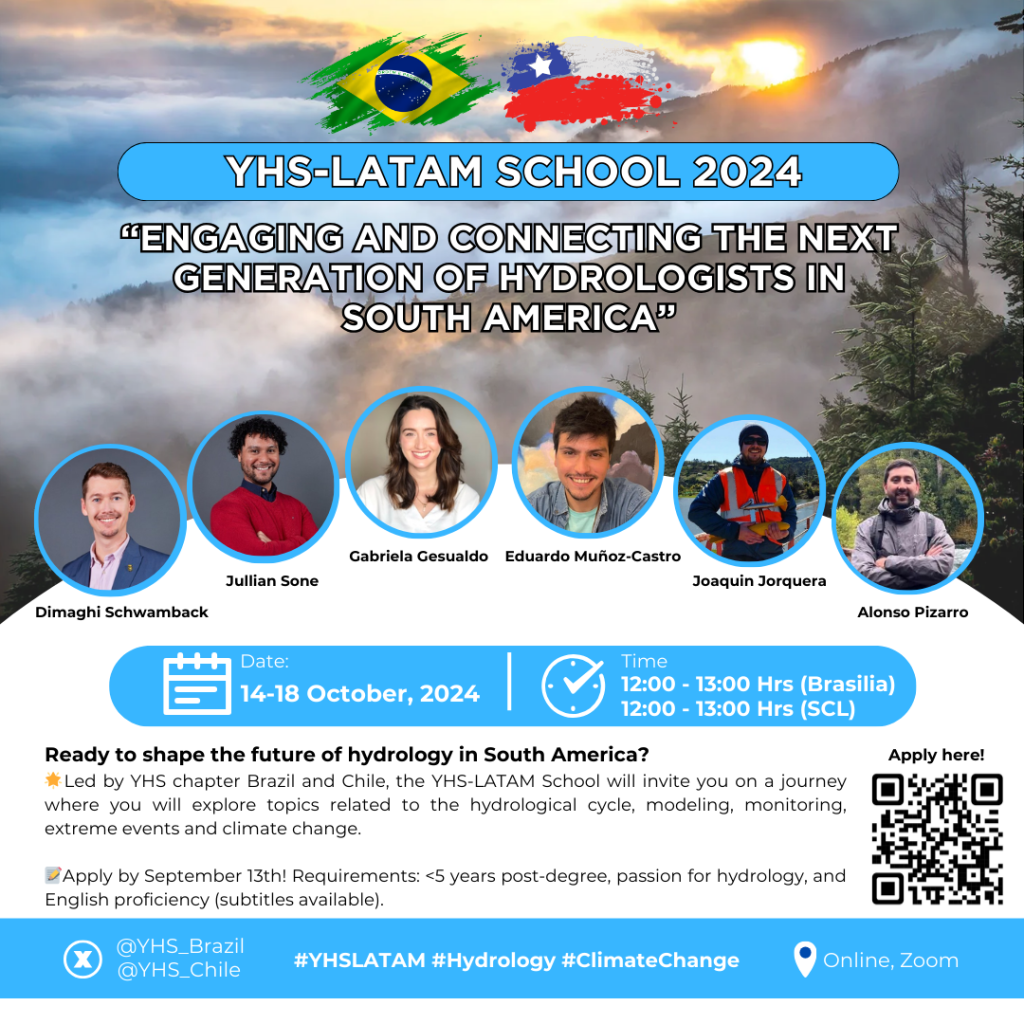
#1st Young Hydrologic Society Latin America school (YHS-LATAM school)- 2024

We are thrilled to announce the first Young Hydrologic Society Latin America school (YHS-LATAM school), an event led by the YHS chapters of Brazil and Chile. This event is dedicated to fostering collaboration and innovation among early-career hydrologists across Latin America.

Register by September 13th at this link : https://forms.gle/TspVf17zjCPb7JpDA

Join us as we delve into critical topics such as water resource management, climate change impacts, and sustainable development. This event promises to be an inspiring and enriching experience for all participants. Check out our preliminary program:

Lecture 1: How is the hydrological cycle in Brazil and Chile? An overview of the hydrological cycle in a warming world
Lecture 2: Introduction to hydrological modeling and process-based assessments
Lecture 3: Innovative monitoring of hydrological processes
Lecture 4: Compounding hydrometeorological extremes event in a warming world
Lecture 5: Introduction to climate change, mitigation and adaptation strategies  

Continue reading
Posted in Events, News, YHS-Brazil | Tagged | Comments Off on #1st Young Hydrologic Society Latin America school (YHS-LATAM school)- 2024

Toward Improved Simulations of Disruptive Reservoirs in Global Hydrological Modeling by Shrestha et al. (2024)

Pallav Shrestha
Pallav Shrestha, Helmholtz Center for Environmental Research

This April (2024), a paper in Water Resources Research caught the attention of our Blog Committee. Intrigued by its innovative findings using a mesoscale hydrology model, we couldn’t resist going deeper. We had the pleasure of discussing this research with Pallav Shrestha, the lead author, and a prominent researcher at the Helmholtz Center for Environmental Research in Germany. Here’s an inside look at our fascinating conversation and the insights we uncovered.


Please introduce yourself to our readers.

I am Pallav Kumar Shrestha. I come from Nepal and currently reside in Germany. I joined the lab of Luis Samaniego at UFZ in 2017 as a PhD researcher, focusing on locally relevant flood forecasting in managed river basins at a global scale. I am one of the active developers of the mesoscale hydrological model (mHM) and the lead developer of the SCC river network upscaling technique and mHM’s reservoir module. My PhD journey is finally coming together with the acceptance of two recent publications: one in Nature Communications and another in Water Resources Research. Today, I’ll delve into the latter.

What led you to integrate a random forest model with the mesoscale Hydrological Model in your study?

While developing the reservoir module in mHM, we were able to satisfactorily represent all aspects of reservoirs based on physics, except for one: the water demand. Demand is a complex human response, highly discontinuous, and is therefore less suited to being modeled as a continuous function like other hydrological processes. For this reason, we hypothesized and demonstrated that machine learning techniques such as random forest could be available option to estimate demand. It is important to note that the random forest modeling exercise was external to mHM, and the fitted demand functions as model input.

Could you explain the significance of the Kling-Gupta Efficiency improvement noted in your study?

Sure. The incorporation of reservoirs in large-scale modeling applications is not a new concept. However, the improvement in Kling-Gupta Efficiency (KGE) for streamflow observed in our study, compared to the naturalized flow, is significantly higher than those reported in previous literature. We succeeded in matching the sub-seasonal details of the observed hydrograph, whereas the majority of previous studies focused only on matching seasonality. The improved KGE implies that modelers can now use mHM to represent reservoir regulation more accurately in their large-scale streamflow simulations.

Continue reading
Posted in Research "Hylight" | Tagged | Comments Off on Toward Improved Simulations of Disruptive Reservoirs in Global Hydrological Modeling by Shrestha et al. (2024)

Navigating parenthood as an early career scientist – Part 2: The question of organization.

A contribution by Diana Spieler, Lina Stein and Rodolfo Bezerra Nobrega

Academia and family are often described as ‘greedy institutions’—a term coined by Coser in 1974. Both demand extensive and open-ended time commitments, which can easily send parents into a spiral of guilt for their perceived inability to fully meet the demands of both their professional and parental roles. This perpetual balancing act is seemingly impossible to perfect. To understand how academic parents navigate these challenges, we asked them how they organize family life around their research demands, how they handle conferences, relocating for the job or their day-to-day routines. This is what they said:

1. Illustration generated by AI technology provided by OpenAI (DALL-E)

Daily Routines

Most parents in our survey reduced their weekly working time to better balance family and career demands. Some choose to work four days a week, while others opt for fewer hours per day. This approach provides flexibility for managing a schedule with kids, particularly when both parents adopt it. By adjusting their work schedules, parents could effectively compensate for each other, stepping in as needed. This however often requires a strong commitment between partners (if not a single carer) in planning daily routines, prioritizing work responsibilities and establishing clear communication channels. It also generally comes with less income.

Organization” is a big part of our family life. […] This insight did not come naturally to me as I am typically terribly unorganized.

While a clear weekly structure and distribution of responsibilities seems essential to most, one respondent reminded us that it is also important to stay flexible in your mind for potential sudden changes. Having plans A, B ,C and possibly even G for important meetings or deadlines can be helpful because there is a definite increase in sick days (of parents and children) or the “occasional calls from the principal for less appealing reasons”.

The most useful strategy for me is to use the early mornings well and to stay flexible in the mind in regards to sudden changes.

Many parents also shared that they sleep less, wake up early or stay up late to handle their workload or catch up on tasks interrupted by family commitments. To compensate for care hours during the week, they sometimes dedicate time on weekends for work. This practice of overworking is common in science (Kucirkova, 2023) and underscores a systemic failure that is especially hard on parents or anyone not following a direct career path (Staniscuaski, 2024). Effective time management and prioritization of tasks seem crucial for maintaining academic productivity without resorting to 60-hour work weeks. This requires working with high focus and efficiency, particularly if time for additional tasks like reading papers or learning new programming skills is necessary.

The most useful strategy for balancing work with family life is to have a pretty clear cutoff when leaving work – I’m unavailable from 4 PM onwards – and having a clear plan for how I will use the limited hours that I am in the office.” 

While some male respondents acknowledged continuing to work full-time while their wives managed childcare, the majority made deliberate efforts to share childcare responsibilities, aiming for a 50-50 or 60-40 split between partners. Achieving a completely even split was often challenging, especially during the child’s first year, but generally became more feasible starting at the age of 1.5 to 3 years old. Shared childcare duties also helped distribute the care of a sick child, arranging schedules around meetings, deadlines and fieldwork and promoting a more equitable distribution of the mental load, which is often disproportionately borne by mothers. One male respondent who worked full-time found it difficult to take parental leave when his child was born, despite being legally allowed. He deliberately advertised to claim your rights and speak up for yourself when it comes to parental leave and reduced working hours as he regretted that it took him at least 8 years before he felt like it was okay to take time off for family.

We need role models! Especially for men that often only know their own fathers as sole providers and mothers as sole caregiver.

Continue reading
Posted in News, Picture | Tagged , , | Comments Off on Navigating parenthood as an early career scientist – Part 2: The question of organization.