EGU16: Hydrology Pop-UpS

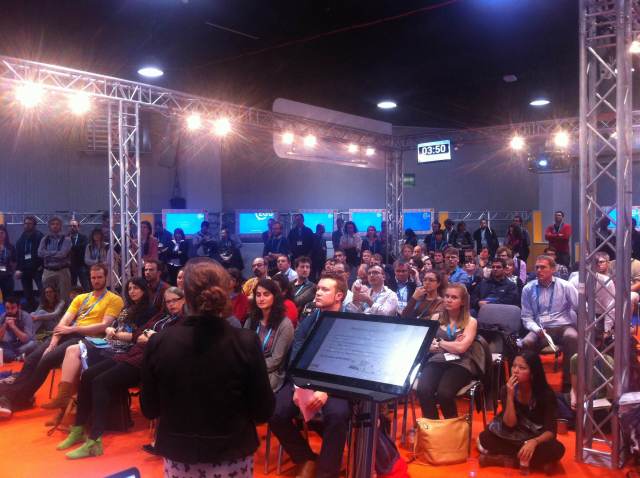
During this year’s pop-up session twelve speakers gave inspiring 5min presentations in which they ‘shared failures, lessons learned and new ideas’, going beyond hour regular conference presentation. Topics ranged from discussing experiences with approaches and ideas that did not work, to innovative ideas in e.g. socio-hydrology and what hydrologists can learn from landslide research.

One of the highlights was a presentation by Natalie Ceperly et al., who shared their difficulties in modeling a fairly simple well-measured catchment in the Alps. Their data is good and their models generally work very well, but for some unkown mysterical reason they are not able to get the model working for two specific years. They’re still looking for an answer and if you have one feel free to contact them.

Another presentation that might got you thinking was by Christopher Hutton, on reproducibility of hydrological modeling results. We, researchers, tend to keep our models, codes and even data to ourselves, and only present the final results. But how do we know whether those results are even real? How can we check another’s research? And how can we make sure that experiments can be repeated?

Summarizing, a lot of food for thought. We aim to organize this session again next year, and preferably even split up in a session (1) focusing solely on sharing failures, and (2) focusing on new ideas, innovative techniques, and inspiring discussions tat will get you thinking.

Contact us if you’re interested in (co-)organizing.
image

Posted in EGU, News | Tagged | Comments Off on EGU16: Hydrology Pop-UpS

Hallway Conversations – Dmitri Kavetski

A –Streams of Thought– contribution by Harsh Beria.

Dmitri Kavetski is a Professor of Civil and Environmental Engineering at the University of Adelaide in Australia. Prof. Kavetski is a renowned expert in the field of uncertainty quantification in hydrologic modeling, having developed Bayesian Total Error Analysis (BATEA) framework (Kavetski et al., 2006a; 2006b) which has been widely used in environmental modeling. He kindly accepted to answer our questions about his early career, his current research interests and how he sees the field of hydrology evolve over the coming decades. Continue reading

Posted in Hallway Conversations, News | Tagged | Comments Off on Hallway Conversations – Dmitri Kavetski

Hallway Conversations – Sally Thompson

A –Streams of Thought– contribution by Kevin Roche.

Sally Thompson is an Assistant Professor of Environmental Engineering at the University of California, Berkeley. Professor Thompson completed her undergraduate studies at the University of Western Australia and worked for several years in environmental consulting. She then moved on to the Nicholas School of the Environment at Duke University as a General Sir John Monash Fellow. Her current research spans an array of fields, including ecohydrology, nonlinear dynamics, and water sustainability. Professor Thompson kindly answered our questions to Kevin Roche (KR) at the 2015 American Geophysical Union Fall Meeting in San Francisco. Continue reading

Posted in Hallway Conversations, News | Tagged | Comments Off on Hallway Conversations – Sally Thompson

EGU16: Rhyme-your-Research

Poetry can be used to make science more accessible to the world, including your students, your professors, your (grand)parents, and the general public. Learn how to write & recite poems about your own research!

More info:
http://meetingorganizer.copernicus.org/EGU2016/session/22103
http://meetingorganizer.copernicus.org/EGU2016/session/22105

egu_poetry

Posted in EGU, News | Tagged | Leave a comment

8 reasons to attend EGU 2016

For all of those doubting whether to attend EGU 2016, here are 8 more reasons to register! This year YHS will organize some revamped classics (Meet the expert, Pop-Ups), and try out some new concepts (How to review, Rhyme-your-research). Times and locations are not known yet, but we’ll let you know as soon as we do! Click on the session titles for more information!

Continue reading

Posted in EGU, News | Tagged | Leave a comment