
The application for the role of Early Career Scientist Representative (ECS Rep) for the EGU Division on Hydrological Sciences (2023-2025) is open!
More details can be found in the official statement.
The application for the role of Early Career Scientist Representative (ECS Rep) for the EGU Division on Hydrological Sciences (2023-2025) is open!
More details can be found in the official statement.
Contribution by Paola Mazzoglio (PM)

Luca Brocca received the M.Sc. degree in Environmental Engineering and the Ph.D. degree in Civil Engineering, both with excellence, from the University of Perugia, Italy, in 2003 and 2008, respectively. Since 2009 he is a Researcher at the National Research Council (CNR), Research Institute for Geo-Hydrological Protection (IRPI) of Perugia (Italy). Since 2019 he is the Director of Research at the same institute. The main research interest of Luca Brocca lies in the development of innovative methods for exploiting satellite observations for hydrological applications (webpage).
PM. Can you tell us a little bit about your background and education? Was becoming a scientist your career plan when you were a student?
LB. I always enjoyed mathematics and environmental science, that’s why I have selected environmental engineering in my city, Perugia. I started studying hydrology because I did my master thesis in this field, then as soon as I got my degree I was selected at CNR-IRPI for a scholarship in Hydrology, and here I am. I did my PhD for studying soil moisture spatial-temporal variability and its use for hydrological modeling, all my career so far has been around the soil moisture topic. The long-term satellite soil moisture product (ESA CCI soil moisture) started in November 1978, the month I was born; I don’t think this is by chance! By the way, I am not a typical researcher as I did my studies and I always worked in my city (with just a very short period abroad)!
Continue readingFaranak (FT) is the incoming President for the Young Hydrologic Society. Here the outgoing President Lina (LS) interviews her about what it is like finishing the PhD, why she would recommend people to join YHS, and what she plans for the future.
LS: You just finished your PhD. Congratulations! How does it feel?
FT: It feels great but a bit sad as well. It feels good, because I actually wrapped up this chapter. At the same time, it is sad not to be a student anymore. I feel a bit nostalgic because I really had good time as a PhD student in Uppsala university.

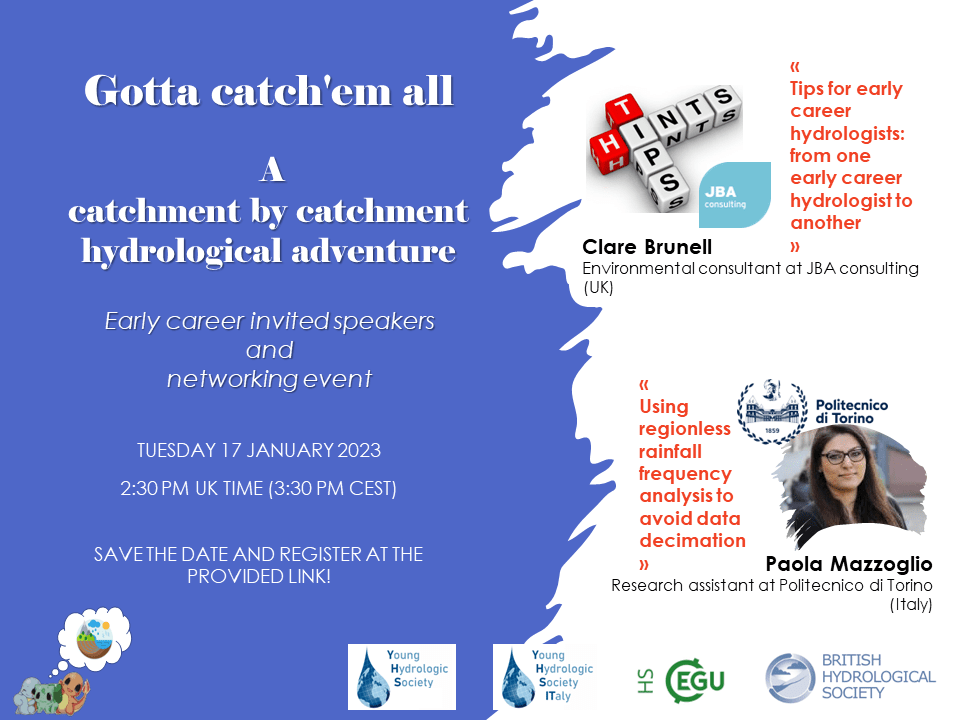
The British Hydrological Society and Young Hydrologic Society would invite you to join the first “Gotta catch’em all” talk on 17th January 2023, 14:30-15:30 CEST. The speakers will talk about hydrology tips and rainfall data decimation.

Contribution by Paola Mazzoglio (PM)
Heidi Kreibich is head of the working group “Flood risk and climate adaptation” at the Section Hydrology, German Research Centre for Geosciences GFZ. Heidi’s research is focused on flood risk assessment and mitigation with a background in Environmental engineering, Hydrology and Geography. Heidi is particularly interested in understanding and modelling flood damage processes and in human-flood interaction. She coordinates the IAHS Panta Rhei Working group “Changes in flood risk”.
PM. Can you tell us a little bit about your background and education? Was becoming a scientist your career plan when you were a student?
I studied environmental engineering at the Technical University of Berlin. Coming from a village in Bavaria, studying in the highly dynamic city of Berlin right after reunification opened up a new world for me. I had a wide range of interests, participated in independent student projects such as self-organised seminars on feminist environmental research and also completed internships in consulting companies, administration and research institutions. Above all, my study project during an Erasmus semester at Lancaster University, UK with Prof. Kevin Jones and my diploma thesis at CSIRO in Melbourne, Australia under the supervision of Dr. Rob Gillett awakened my passion for science and I decided to do a PhD and go into research.
Continue reading Young Hydrologic Society