
Let’s get the basics. Name, where you are from, and your current affiliation, advisor and profile?
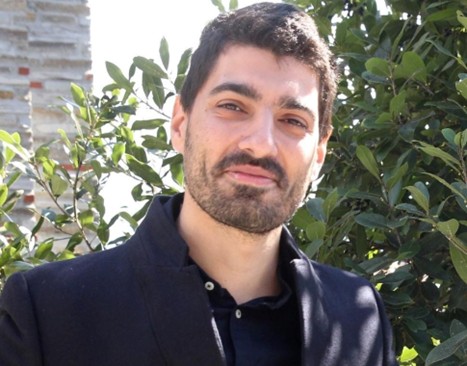
My name is Vangelis Findanis, and I come from Greece, specifically from the Island of Lesvos. I have resided in Thessaloniki for the last 15 years, from the beginning of my undergraduate studies to my seventh year as a PhD student. Currently, I am pursuing a PhD in the Department of Rural and Surveying Engineering at the Aristotle University of Thessaloniki. My advisor is Professor Athanasios Loukas.
What is the research you are currently working on?
My research focuses on applying concepts of information theory to surface hydrology to quantify the uncertainty components of rainfall-runoff models. Information theory originally came from the field of electrical engineering, and it studies the quantification, transmission, and encoding of information. Applications of information theory are everywhere around us, from Morse code to ZIP files and podcasts. To put it simply, without it, our technological world would be infeasible. A key concept of information theory is Shannon’s entropy, which is linked to thermodynamic entropy, implying that information is as physical as energy and mass. Therefore, in a hydrological model, a balance of information must be conserved between its inputs and its outputs, just like the volume of precipitation minus the hydrological losses must be equal to the volume of runoff. Any deficit in that balance is derived by uncertainties entangled in the model’s structure or selected parameters. Hence, by computing this information deficit, the components of uncertainty in a hydrological simulation can be identified and improved.
What got you started on this current research? Was there some epiphany or light bulb moment?
Nowadays, an “eureka” moment rarely exists in science. The main idea behind my research originated from the literature review I conducted at the start of my PhD journey, as other researchers had previously recognized the potential application of information theory to hydrology. I believed that insufficient research had been done at the interface of these two fields, and I gave it a try.
What’s your dream job, academic or otherwise?
My dream job is putting the theoretical knowledge of hydrology and hydraulic engineering into practice to build hydraulic structures that serve local communities. I believe that combining academic knowledge and engineering practice broadens the horizons of every scientist, since academia and industry are the two faces of the same coin; one needs the other to fulfill its cause. This cause is the development and improvement of humankind by simultaneously protecting the natural environment.
What is your favorite non-traditional source of science news (blog, podcast, etc)?
Many YouTube videos explain science concepts and news more effectively than classical textbooks and papers, as they often feature astonishing graphics that visualize the hidden beauty behind seemingly laborious and abstract fields. Moreover, there are numerous high-quality YouTube podcasts and tutorials on software packages like HEC-RAS or QGIS, which serve as an introductory crash course or inform the viewer about new features and updates. Personally speaking, I was introduced to HEC-RAS by watching YouTube videos. After that, I elaborated on the subject by studying the software’s manual. My second favorite non-traditional source is blogs and forums, which are beneficial when coding or learning a new programming language.
Check out Vangelis Findanis’s website for more information about his work and reach him.
 Young Hydrologic Society