
Let’s get the basics. Name, where you are from, and your current affiliation, advisor and profile?
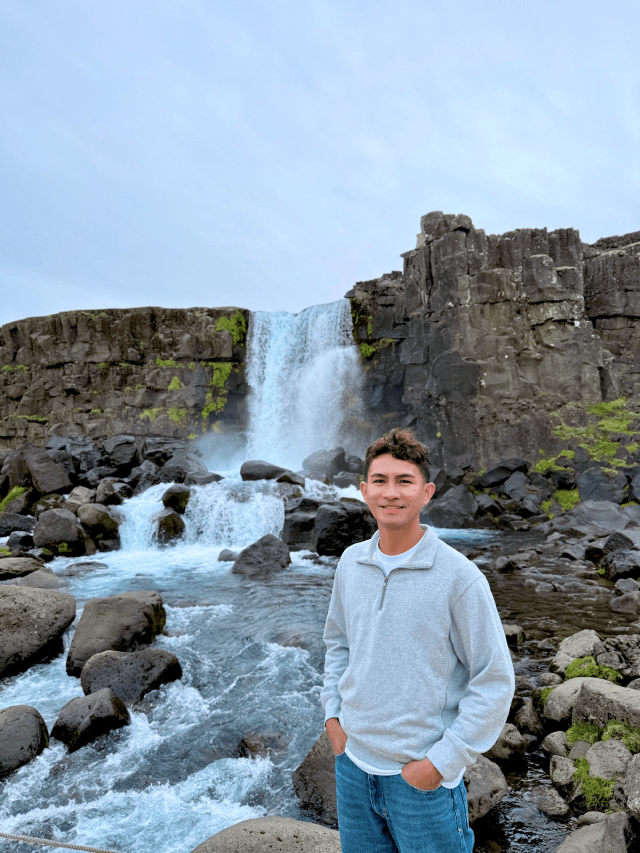
Hi, my name is Mark Bryan Alivio, and I am originally from a small city, named Valencia, in the island of Mindanao, the Philippines. I received an MSc in Water Science Engineering (Flood Risk Management) through the Erasmus+ Flood Risk Master program. I am currently doing my PhD at the University of Ljubljana, Faculty of Civil and Geodetic Engineering, under the supervision of Prof. Nejc Bezak.
What is the research you are currently working on?
My research focuses on the role of urban trees as nature-based solutions (NbS) for stormwater management in cities. Yes, I know everyone thinks that trees have been extensively studied for their runoff reduction (I got this comment a lot when I opened up what I am currently working on), but that is only true in forest or rural environments, not in an urban setting. Trees in cities exhibit different vegetation characteristics (e.g., leaf area index, canopy structure, phenology) compared to their forest counterparts due to different growing conditions, microclimate, and other factors. Also, the representation of urban trees (even afforestation) in most existing hydrologic models is typically based on land use/land cover type, and the hydrologic response to these changes is used as a basis for determining the equivalent runoff reductions and water quality benefits provided by trees. Also, the data, variables, and/or parameters characterizing trees and the canopy hydrological processes (i.e., interception, throughfall) have been mostly supplemented with findings from studies in natural or rural forests.
So, I am currently measuring the rainfall partitioning (interception, throughfall, stemflow) in birch and pine trees in an experimental urban park. This data will be used to estimate species-specific parameters (i.e., canopy storage) to be used for canopy hydrological modelling that can be calibrated and validated with observed throughfall and stemflow data. Currently, existing urban hydrology or stormwater models oversimplify the representations of trees and their canopy hydrological processes, particularly in urban environments. Hence, we are specifically modelling the dynamics of rainfall interception, throughfall, and stemflow for birch and pine trees using an updated SWMM model, comparing our simulation results with measurements from our experimental plot, and then evaluating the stormwater reduction potential of each tree species. I think our research will benefit policy-makers, stormwater managers, and urban foresters about the importance of integrating trees into urban green infrastructure and support urban greening efforts. For cities to fully embrace trees as part of their stormwater management strategies, we need to move forward by treating them as functional green infrastructure, backed by local/species-specific data and research-based evidence, not merely as landscaping elements.
What do you wish you had known when you started your graduate/academic career?
I chose to answer this question because I think this is very important for anyone considering a PhD but feeling hesitant about whether they can manage it. Like many people I know, I had little to no knowledge about the life of someone doing a graduate/academic career, as nobody from my family has done so. But my curiosity brought me where I am now. So, what I wish I had known when I started doing my MSc and PhD is that first, it’s okay not to have everything figured out from the beginning. Your research path unfolds step by step, and what I think truly matters is to stay open, remain curious, determined, and strive for quality research. This academic journey is a roller-coaster ride of emotions and experiences. There are moments of doubt, frustration, and exhaustion, but also moments of discovery, growth, and quiet victories that make the struggles worthwhile. Even small progresses like arranging your references, organizing the table of contents, formatting your figures and tables, and making sense of messy datasets truly matter and are worth celebrating with a slice of your favorite cake or a glass of Aperol spritz.
Second, and I think most importantly, is that having a work/research-life balance matters deeply. At the beginning, I often found myself consumed by literature review, data processing and analysis, modelling, and the pressure to achieve more. But over time, I was reminded that stepping away from the desk and closing my laptop/PC does more than staying longer in front of the screen. I realized that I am in Europe and having breaks/vacations is a right and not a privilege. Taking walks, traveling, sitting in a café or by the river, attending free concerts, and meeting friends have become my moments of pause, which give me the space to breathe and simply live in the present. Of course, this was initially a challenge, as guilt would sometimes whisper that I should have spent those hours or days working on my research. But I learned to manage my time effectively, and allowing myself this “me time” is what kept me sane, motivated, and able to return to research with fresh energy and perspective.
Lastly, I wish I had known that not everyone will see or understand the enormity of the unseen efforts you put into your research, and it is fine, as long as you yourself recognize and acknowledge the work you put in.
Aside from a lab bench, where has your research taken you?
Outside the experimental plot (instead of a lab bench), my research has taken me to different cities and countries (and some of these are my dream countries to visit) for conferences, where I had the opportunity to meet scientists, hydrologists, and fellow PhD students (some became my friends), who inspired me to continue pushing my research forward. I’m also fortunate that my supervisor is bringing me to project meetings, which expose me to how research projects are planned, executed, and managed. Many of these meetings include excursions to other experimental catchments and plots, which are always fascinating to see and provide valuable learning experiences about different field methods and site conditions. So, I think it’s not just about “where” my research has taken me, but also about “who” I’ve met along the way.
If you were not a young hydrologist, what would you be doing?
Becoming a civil engineer was my dream from a young age. When I was a kid, I admired buildings, bridges, roads, and skyscrapers, and I was curious about how they were designed, constructed, and stood the test of time. I dreamed of being part of such projects and contributing until completion. So, if I were not a young hydrologist today, I would still be pursuing work or research related to structural engineering or perhaps in material science, developing innovative materials for civil engineering applications.
What got you started on this current research? Was there some epiphany or light bulb moment?
What truly sparked my interest in flood risk management and in my current research on NbS was not one single light bulb moment, but rather a series of experiences that made me more aware of the pressing realities we face, especially in the Philippines. I grew up seeing my close relatives experience flooding, but the problem struck me more deeply when I experienced it myself one Christmas vacation, walking through neck-level floodwaters. A few years later, another storm devastated the city where my relatives lived, destroying homes and livelihoods. Those moments stayed with me. As I pursued graduate studies, I realized something important: while civil engineering students in the Philippines are trained extensively in construction and project management, there is little emphasis on water-related hazards, sustainable flood management, and NbS, areas that are increasingly relevant and urgently needed in my home country.
Now, working on my PhD in NbS for floods, I see more clearly that traditional gray infrastructures alone are not enough to address the flooding, and the potential of using NbS, like urban greening, “room for the river”, not only to manage stormwater and runoff but also to build healthier, more sustainable communities. Along this journey, I also became more aware of the lag in water resources engineering education in the Philippines, neglecting the more sustainable, integrated water management approaches. Perhaps this is one of the reasons why government projects still overwhelmingly prioritize dikes and hard infrastructures despite repeated evidence of their inadequacy when tested by typhoons. For me, it’s about finding solutions that can truly protect people and communities in the long term by looking at the problems holistically and educating our communities and future leaders with relevant knowledge, skills, and tools. Working with nature and not against it, because when nature fights back, it usually wins.
 Young Hydrologic Society